Luxury cruises in 2026 are no longer like those from five years ago. Ships are getting smaller, passengers are getting younger, and European regulations are pushing companies to rethink their itineraries as well as their propulsion systems. What is at stake this year goes beyond mere onboard comfort.
European Regulation and Luxury Cruises: What Changes in 2026
Have you noticed that some Mediterranean itineraries are disappearing from high-end catalogs? The reason can be summed up in three acronyms: FuelEU Maritime, EU ETS, and OPS. These European texts impose a gradual reduction in the carbon intensity of energy for ships calling at EU ports, with high financial penalties for non-compliance.
The most visible aspect concerns electrical power supply at the dock. By 2030, large passenger ships will be required to connect to the onshore power grid in major European ports. Companies investing in the luxury segment are already anticipating this deadline.
This regulatory framework has a direct effect on destination choices. Shipowners are favoring ports equipped with OPS infrastructure, which benefits certain already modernized Nordic or Mediterranean stops while excluding others. To keep up with the trends in luxury cruises 2026, one must now read both port bulletins and company brochures.
Traveler Profile: 18-35 Year-Olds Disrupting the High-End Cruise Market
Luxury cruising is no longer reserved for wealthy retirees. Recent data shows a marked youth trend among clients. At MSC, 34% of bookings from 18-35 year-olds are for the Mediterranean. The share of this age group booking Caribbean itineraries has surged significantly between 2024 and 2026, reaching about 40% of 2026 bookings.
Why this shift towards the Caribbean? Several factors are at play simultaneously.
- Young travelers are seeking itineraries focused on pleasure and immersive experiences, not just the classic cultural heritage of Mediterranean stops.
- Premium offerings now include themed cruises (gastronomy, wellness, adventure) that appeal to a clientele accustomed to personalized stays.
- The short format, five to seven nights, better fits the professional constraints of this generation than a three-week world tour.
This evolution forces companies to rethink their onboard services. Coworking spaces, cutting-edge wellness programs, and constant connectivity are becoming criteria for choice, alongside suite size or dining quality.
Luxury Cruise Destinations 2026: Arctic, Amazon, and Small Capacities
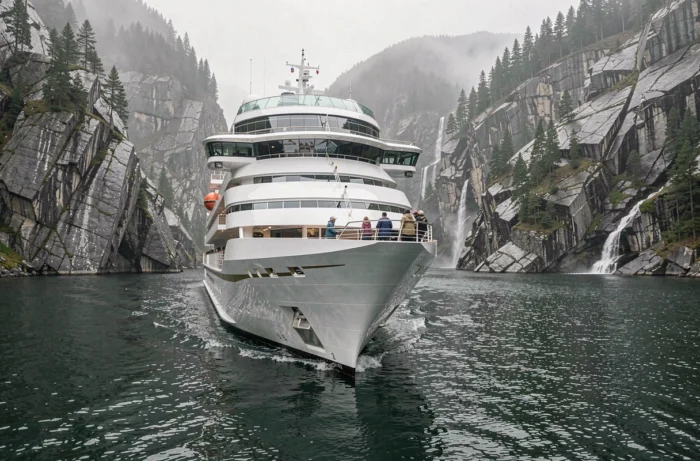
The rising itineraries in 2026 share a common point: they focus on isolation rather than accumulating stops. The Arctic, from Svalbard to Greenland via Norway, attracts clientele willing to pay more for expeditions without a fixed itinerary. Companies like Selar, founded by Sophie Galvagnon (the first female captain in polar regions), offer ships limited to 36 passengers.
The Amazon follows the same logic. New expedition boats designed for the river combine shallow drafts with high-end services. The principle is simple: fewer passengers, more flexibility to access areas inaccessible to large cruise ships.
Mediterranean and Caribbean Remain Top in Volume
These exploratory destinations do not replace the classics. The Mediterranean retains its position as the top cruise area, driven by geographical proximity for European travelers and the density of cultural stops. The Caribbean is progressing thanks to the influx of the young clientele mentioned earlier.
The difference lies in positioning. In the Mediterranean, the luxury segment distinguishes itself by offbeat stops (small Greek islands, Montenegrin coasts) rather than the crowded ports of Barcelona or Civitavecchia. In the Caribbean, premium companies are developing private islands with exclusive access.
Next-Generation Ships: What 2026 Launches Change
Several launches mark this year. The Explora III, the Four Seasons One, and other units are coming out of the shipyards in Saint-Nazaire, Turku, or the Indian Ocean. What distinguishes them from previous generations lies in three technical choices.
- Deliberately reduced capacity: most accommodate fewer than 200 passengers, sometimes fewer than 50, to ensure a very high crew-to-passenger ratio.
- Hybrid or LNG propulsion: compliance with FuelEU Maritime is pushing shipyards to integrate less carbon-intensive propulsion systems from the design stage.
- Modular interior architecture: suites can transform into work or wellness spaces, catering to a clientele that refuses to choose between vacation and productivity.
These ships are not miniature versions of giant cruise liners. Their design starts from an opposite premise: maritime luxury in 2026 is defined by what is removed (queues, crowds, noise) rather than what is added.
The high-end river cruise segment is following a parallel trajectory. The Danube, Rhine, and Mekong are attracting operators who apply private yacht codes to inland navigation. Cabins with balconies, locavore cuisine, and walking excursions from the dock replace standardized packages.
The luxury cruise market in 2026 is structured around a productive tension: strict regulatory constraints on one side, a demand for radical personalization on the other. Companies that are thriving are those that turn these constraints into a commercial argument, making energy efficiency and small capacity markers of prestige rather than endured compromises.