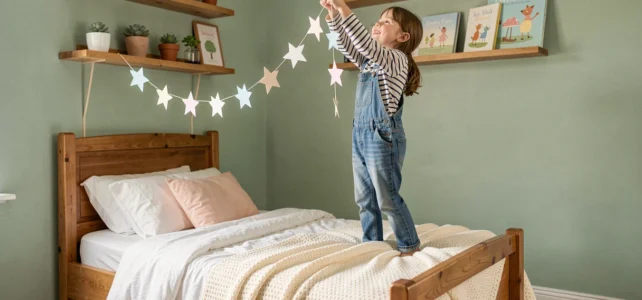
The decoration of a child’s room is based on a principle often overlooked: the space should function as a complete living area, not just a place for sleeping. Bed, storage, play area, and quiet corner coexist within a few square meters, and every choice of furniture or color influences daily use.
Current trends confirm a shift towards minimalist atmospheres, gender-neutral palettes, and materials whose health quality has become a key selection criterion.
Health labeling of paints and materials in children’s rooms
Before choosing a color or wallpaper, the question of volatile organic compound emissions deserves attention. Specialized guides recommend selecting paints and coatings that carry the health label A+, the lowest emitting class on the French regulatory scale.
This criterion also applies to furniture, rugs, and textiles. A low-quality particle board piece can emit formaldehyde for several months after purchase. Prioritizing solid wood, rattan, or certified panels significantly reduces this risk.
To find children’s decorative accessories designed with this quality requirement, several specialized shops offer suitable ranges, such as https://www.sidonieetgedeon.fr/, which brings together decorative objects and furniture for children’s rooms.
Gender-neutral color palette: beyond pink and blue
The gender-neutral room is no longer a marginal style. It is becoming a design standard, conceived from the outset to evolve with the child’s age and potentially accommodate another occupant without a complete overhaul.
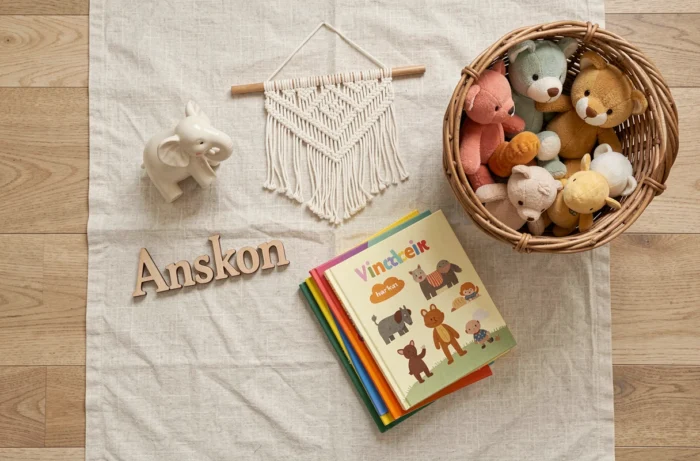
Earthy palettes dominate: khaki, camel, clay, sage green. These shades easily combine with each other and with light wood or rattan furniture. The result creates a soothing atmosphere, far from the visual overload of heavily themed designs.
Combining colors on the walls
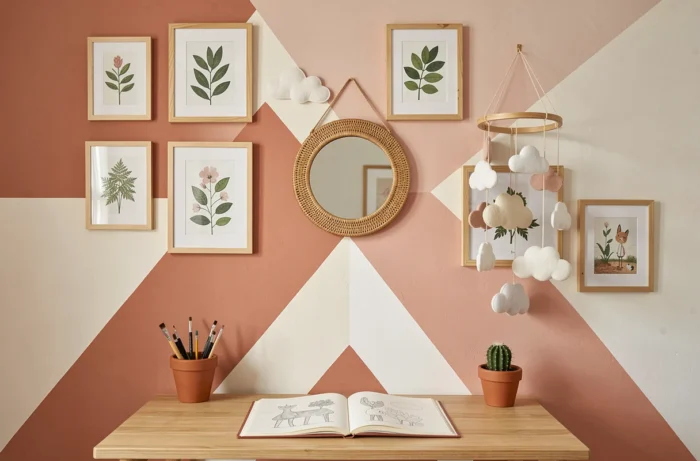
Painting a single wall in color (accent wall) and leaving the others in a neutral shade remains the simplest method to visually structure the space. A half-painted wall, with a horizontal demarcation at mid-height, works particularly well in small rooms: it visually enlarges the space without overwhelming it.
Another option: panoramic wallpaper on a single wall, featuring plant or animal motifs treated in soft tones. Jungle or savannah scenes in a watercolored version replace overly literal decors and age better.
Slow design in children’s decoration: fewer objects, more structure
Slow design applied to children’s rooms starts from a simple observation: children need clear floor space to play, crawl, and build. Multiplying small decorations reduces this space and creates a visual burden that disrupts calm.
The trend is to invest in a few quality structural pieces rather than an accumulation of accessories.
- A well-chosen bed (cabin bed, Montessori-inspired floor bed, or convertible bed) that becomes the focal point of the room and accompanies the child for several years.
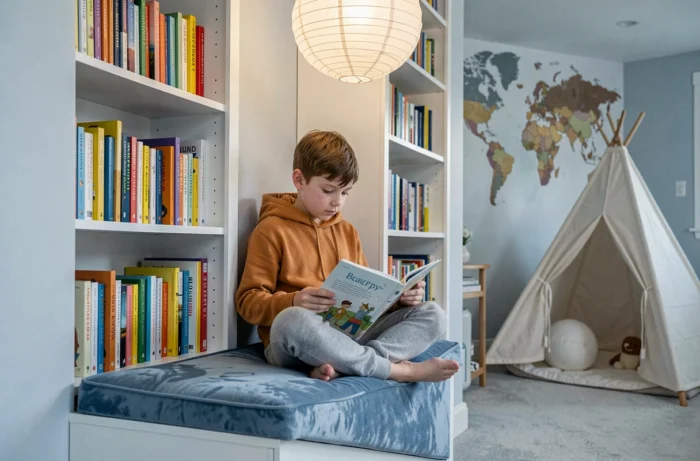
- A low storage unit accessible to the child, such as an open shelf or fabric bins, allowing them to participate in tidying up as soon as they can walk.
- A thick, washable rug that defines the play area and provides thermal comfort to the floor.
- One or two wall decoration elements (personalized poster, visible book shelf) that are enough to give character without overcrowding.
The mistake of the catalog room
Completely reproducing an atmosphere seen on social media often results in a static outcome, designed for the photo and not for use. A growing child changes their interests every six months. A neutral base with easily replaceable decorative elements (cushion covers, posters, garlands) allows for following these changes without repainting or refurnishing.
Trendy accessories to personalize the room without overcrowding
Personalizing a child’s room involves targeted choices rather than accumulation. A few categories of accessories stand out for their ability to transform the atmosphere with limited investment.
Lighting and night lights
Lighting directly influences the atmosphere of a room. A rattan or linen pendant light diffuses a soft, warm light, preferable to ceiling lights with direct white light. Soft silicone night lights, rechargeable, serve as both a reassuring light source and a decorative object that the child can handle.
Textiles and bedding
Bedding is the most accessible lever for personalization. Washed cotton covers in pastel or terracotta tones can be changed in minutes and radically alter the ambiance. Floor cushions, cotton gauze throws, and bed canopies complement the textile setup without weighing down the room.
- Prioritize natural materials (organic cotton, linen) for direct contact with the child’s skin.
- Choose timeless patterns (stars, polka dots, wide stripes) rather than character licenses that quickly go out of style.
- Opt for shades coordinated with the walls to maintain visual coherence throughout the room.
Wall decor and visible storage
Thin wall shelves, on which books and small objects are displayed face up, replace traditional frames advantageously. They can be reorganized in seconds and the child participates in choosing what is displayed, reinforcing their ownership of the space.
Repositionable wall stickers offer an alternative to wallpaper for creating a temporary thematic universe. Applied to a wall painted white or in a light shade, they can be removed without damage when the child moves on to something else.
The decoration of a child’s room gains longevity when it is based on a sober foundation, healthy materials, and a few well-chosen accessories. The last point to keep in mind: always check the emission class of products introduced into the room, including textiles and small auxiliary furniture.