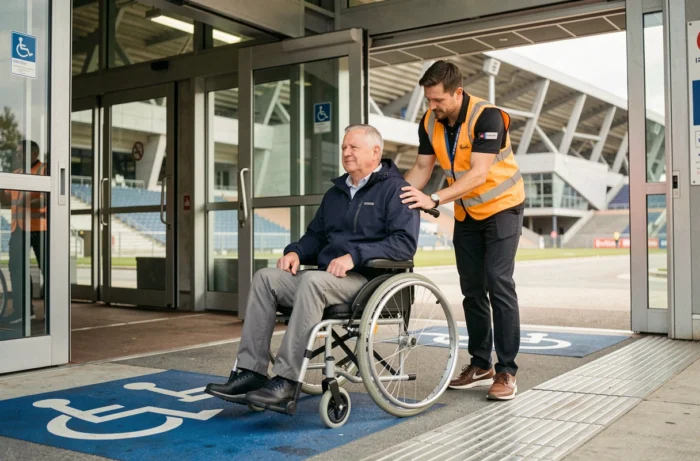
Obtaining disabled access to visit a stadium involves navigating through several procedures: documents to provide, sometimes poorly adapted ticketing, and information scattered across club websites. However, the French regulatory framework requires sports venues, classified as establishments open to the public (ERP), to ensure the reception of people with disabilities. The reality on the ground remains uneven depending on the stadiums, types of disabilities, and digital tools available.
Digital Accessibility of Ticketing: The Often Neglected Link
Most content addressing accessibility for people with reduced mobility (PRM) in stadiums focuses on physical arrangements (ramps, reserved seating, restrooms). They overlook a prior obstacle: the online ticketing itself.
Since Law No. 2023-171 of March 9, 2023, and Decree No. 2026-816 of August 24, 2026, the online public communication services of stadiums managed by public bodies must comply with enhanced digital accessibility requirements, aligned with Directive (EU) 2019/882 and the RGAA reference framework. Specifically, assistance request forms, access maps, and PRM reservation pages must be compatible with screen readers and navigable via keyboard.
Financial penalties may be imposed in cases of repeated non-compliance. For spectators, this means it is legitimate to demand disabled access to visit a stadium right from the online booking phase, without having to resort to a phone call or an unanswered email.
However, feedback from the field varies on this point: some professional clubs offer a smooth digital process with the option to choose PRM seating, while others redirect to a single phone number, which can be overwhelmed on match days.
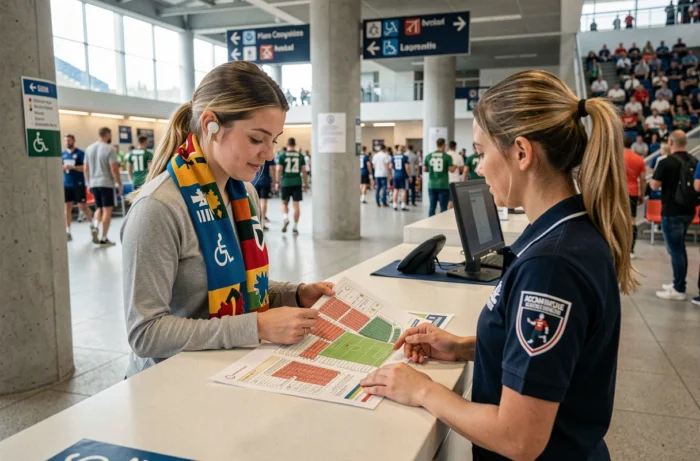
Mobility Inclusion Card and Supporting Documents: What the Stadium Can Require
The Mobility Inclusion Card (CMI) indicating “disability” or “priority” is the main document requested by most sports venues. It has replaced the old disability and priority cards for several years.
When booking, the stadium or club may request:
- A valid copy of the CMI, or a receipt of application with the MDPH if the card has not yet been issued
- An additional document specifying the type of disability (motor, sensory, mental), to guide towards the appropriate location (wheelchair space, seat with a removable armrest, area with a hearing loop)
- The name of the companion if the stadium offers free or reduced rates for the person assisting the disabled spectator
Some stadiums also accept the RQTH certificate or a recent medical certificate, but this is not systematic. The CMI remains the most universally recognized document and avoids discussions at the ticket counter on the day of the event.
Companion: Free or Paid Depending on the Stadiums
The pricing policy for companions varies from club to club. At the Stade de France, the companion seat is offered at a reduced rate or free depending on the event. Other venues charge the full price for the seat. No uniform legal obligation mandates the companion’s free access, creating a disparity that disability advocacy groups regularly denounce.
Sanctions and Controls: What Has Changed Since 2025
The law of February 11, 2005 established the principle of total compliance for ERPs before 2015. This deadline has not been met in most cases, and the Accessibility Agenda (Ad’AP) system has extended the deadlines. Since April 2025, 23 sanctions have been imposed regarding ERP accessibility, according to France Info.
This figure remains modest compared to the total number of establishments concerned. Nevertheless, it indicates a shift in the posture of the control authorities, which are gradually moving from a support approach to an effective sanction approach.
For a spectator with a disability, this evolution has a practical consequence: stadiums that have still not submitted or completed their Ad’AP are exposed to penalties. A spectator can report an accessibility issue to the prefecture or to the municipal accessibility commission of their city, which feeds into administrative follow-up.
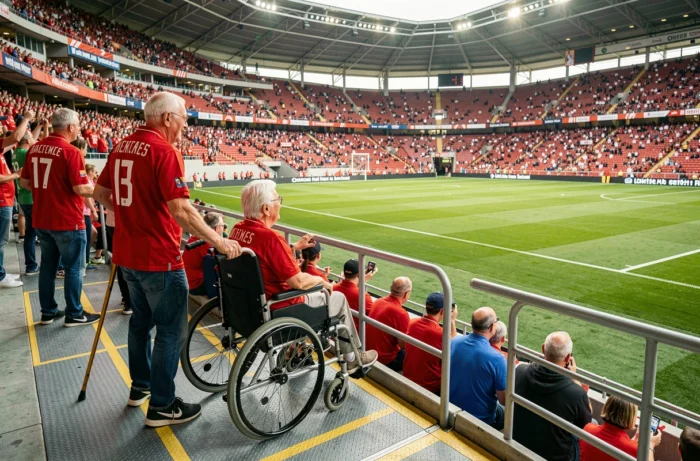
PRM Seats in Stadiums: Number, Location, and Distribution by Category
The decree of April 20, 2017, sets the minimum number of seats reserved for people with disabilities based on the total capacity of the establishment. The locations must be distributed among the different categories of seats offered to the public, and not grouped in a single area.
This point is regularly a source of frustration: in several stadiums, PRM seats are found exclusively in the lower stands, sometimes behind plexiglass or at pitch level, which limits visibility. The distribution by category (side stand, corner, VIP stand) remains an objective that few venues fully achieve.
Accessible Parking and Pathway to the Stand
Reserving a PRM seat does not guarantee an obstacle-free route between the parking lot and the seat. The available data do not allow for a detailed assessment of each stadium, but several points deserve verification before match day:
- Existence of a PRM parking area close to the dedicated entrance, with spaces of regulatory dimensions
- Appropriate signage (guiding strips, pictograms, contrasting signs) between the parking and the stand access
- Presence of trained staff to assist people with disabilities along the pathway
- Functional elevators or access ramps on the day of the event, and not just in theory
Contacting the stadium’s accessibility service a few days before the event remains the most reliable method to confirm the actual conditions of the route.
Stadium accessibility is progressing due to the combined effects of regulatory tightening, effective sanctions, and advocacy pressure. The journey of the disabled spectator begins well before reaching the stands: it starts on a screen, facing a booking form. This is often where the simplicity, or complexity, of the entire process is determined.