The technological news of the start of the 2026 school year is not just about product launches. With a tightening European regulatory framework on generative AI, smartphone manufacturers rethinking the very format of their devices, and a rapidly changing refurbishment sector, developments are occurring on multiple fronts simultaneously. Here are the high-tech trends shaping the end of the year.
AI Act: What the August 2026 obligations change for tech products in Europe
Since August 2, 2026, the provisions of the AI Act concerning consumer generative AI have become operational. Chatbots must clearly inform users that they are interacting with an automated system. Images, videos, sounds, and texts produced or modified by AI must be technically labeled as machine-generated.
This labeling is not limited to a simple text warning. It involves a technical layer integrated into the files themselves, directly impacting software publishers, content creation platforms, and camera manufacturers with AI features. A sanctions regime is now operational in case of non-compliance.
Tech enthusiasts following all the news on La Caverne du Geek recognize the extent of the change: every product incorporating generative AI sold in the European market must comply with these obligations, whether designed in San Francisco or Shenzhen.
A less publicized obligation also deserves attention. Since February 2025, the AI Act requires organizations deploying AI systems to ensure a sufficient level of AI culture and mastery among the individuals using them. This requirement for “AI literacy” affects product documentation, user interfaces, and the training of technical support teams.
Field feedback varies on how companies are concretely applying this obligation, but its existence is already changing the design of digital tools intended for the European market.
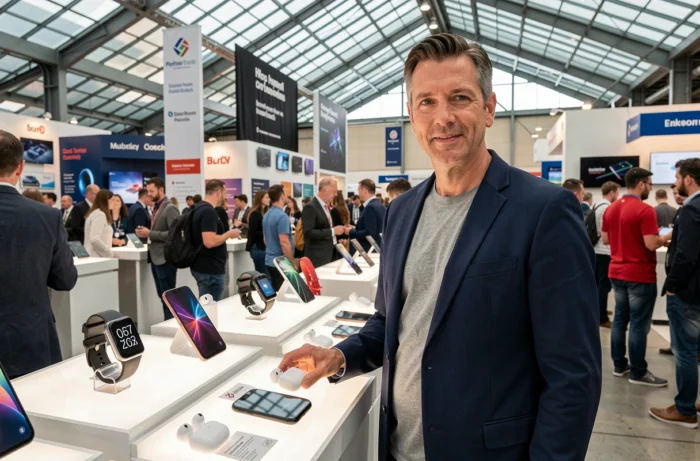
iPhone Duo and foldable smartphones: the format that divides the market
Apple has officially announced the iPhone Duo, its first foldable smartphone, with availability set for late October 2026. The listed price, around several thousand euros, reignites a recurring debate about the relationship between form innovation and access price.
Samsung has occupied this segment for several generations with its Galaxy Z Fold range. Apple’s entry validates the foldable format as a lasting category, but the available data does not yet allow for conclusions about mass adoption by the general public. The cost remains a structural barrier.
What the foldable changes for the user
A screen that unfolds does not just provide a larger surface. It transforms the ergonomics of productivity applications, video viewing, and multitasking. However, the thickness of the device when folded, the fragility of the hinge, and the weight exceeding that of a conventional smartphone are compromises that each buyer must evaluate.
The foldable is aimed at a specific use, not as a universal replacement for the conventional smartphone. Manufacturers that succeed in this segment will be those who identify sufficiently differentiating use cases to justify the extra cost.
Refurbishment and sustainability: tech facing its material footprint
The refurbished smartphone market continues to structure itself in France. Specialized platforms are refining their quality control processes, and the warranties offered are gradually approaching those of new devices. The sector remains marked by disparities: not all refurbishers apply the same testing standards, and transparency regarding the actual condition of batteries remains a point of concern.
Several factors are driving this market:
- The continuous rise in the average price of new smartphones, exacerbated by foldable models and premium ranges with embedded AI
- A growing consumer sensitivity to environmental issues, even though price remains the primary purchasing driver
- The European regulatory framework pushing manufacturers towards better reparability and a more readable durability index
The question of what happens to old phones remains unresolved. A significant portion of used devices lies dormant in drawers instead of being reintegrated into the refurbishment or recycling circuit. The trade-in programs offered by operators and manufacturers still struggle to capture this dormant stock.

AI and digital security: the alerts accompanying the acceleration
The acceleration of generative AI deployment does not come without friction. Researchers who have worked at OpenAI and Anthropic publicly express concerns about the pace of development and associated risks. These positions, relayed by the mainstream press, fuel a debate that extends beyond the circle of specialists.
OpenAI recently mobilized thousands of AI agents to attempt to solve an old mathematical problem, illustrating the computing power now accessible. Meanwhile, Meta has decided to abandon professional fact-checking in several Latin American countries in favor of community notes, a choice that raises questions about the reliability of information in AI-driven ecosystems.
Connectivity and physical vulnerabilities
Threats are not solely software-based. Recent research shows that a solar storm can disrupt GPS systems, including those embedded in autonomous vehicles. This vulnerability serves as a reminder that the growing dependence on connected technologies exposes us to risks of natural origin, not just cyberattacks.
Connected devices, from Bluetooth watches to smart thermometers, continue to multiply in households. Each new device added to the home network expands the potential attack surface. Securing these ecosystems remains an ongoing challenge for manufacturers and users alike.
The tech start of 2026 is characterized by this tension between the acceleration of supply and the structuring of safeguards. The European regulatory framework is advancing, product formats are diversifying, and sustainability issues are gaining visibility. The coming months will reveal whether these dynamics converge towards a more mature market or if they exacerbate the fragmentation between early adopters and the general public.