
Leisure time corresponds to the remaining time slot once work, commutes, and domestic obligations are taken out of the day. Its average duration has increased in France since the 1980s, but the way it is spent has profoundly changed with the proliferation of screens and digital distractions.
Fully enjoying these moments requires choosing activities that meet a genuine need, whether physical, cognitive, or social, rather than being absorbed by the passive scrolling of a news feed.
Leisure time and dopamine: why some hobbies recharge better than others
Not all relaxation activities have the same effect on the brain. Physical exercise, actively played or listened to music, and time spent outdoors stimulate the production of dopamine and serotonin, two neurotransmitters directly linked to motivation and mood regulation. Conversely, prolonged scrolling on a smartphone causes brief spikes in dopamine followed by rapid drops, leading to a feeling of fatigue without real rest.
Choosing a hobby based on its neurological effect changes the game. A thirty-minute walk in the woods, a cooking session, or playing a piece on the guitar are not just pleasant pastimes: these activities measurably restore attention capacity. Boredom itself, when accepted without immediately resorting to a screen, reignites creativity by forcing the brain to produce its own stimuli.
Before seeking the perfect activity, a simple diagnosis involves assessing one’s available energy level. To explore leisure activities on On ne m’avait pas dit que, sorting can be done between calm activities (reading, drawing, journaling), moderate activities (gardening, board games), and stimulating activities (sports, dance, climbing). This classification by intensity prevents frustration in front of an endless list of ideas unsuitable for the present moment.

Micro-adventures close to home: original ideas without traveling far
The trend of micro-adventures has gained momentum in recent years. The principle: to have an immersive experience within a radius of a few dozen kilometers from home, often for half a day or a night. Camping allowed in certain state forests, swimming in wild rivers, night hiking with stargazing, or family geocaching in a regional natural park.
The appeal of these short formats goes beyond mere entertainment. A micro-adventure breaks the routine without the logistical constraints of a trip, and the change of scenery begins as soon as the usual setting changes. Sleeping one night in a tent an hour’s drive from home provides a sense of escape comparable to a long weekend, according to frequent feedback in outdoor communities.
Some micro-adventure formats to try
- Themed staycation: transform a weekend at home into a tourist stay in your own city by visiting places you always put off (museum, unknown neighborhood, craft market)
- Nature challenge with family: follow a marked trail with a specific mission like identifying five species of trees, photographing animal tracks, or mapping a stream
- Dusk outing: set off on foot or by bike an hour before sunset to reach a viewpoint, with a light picnic and a headlamp for the return
These activities are particularly suitable for vacations with children because they combine movement, observation, and play without requiring a special budget.
Creative manual hobbies: slowing down to enjoy better
The resurgence of creative manual hobbies (sewing, pottery, embroidery, woodworking) meets a specific need: to produce something tangible with one’s hands. This type of activity mobilizes sustained but non-stressful attention, a state that psychologists call flow. The brain focuses on a technical gesture, the perception of time changes, and satisfaction comes from the physical result obtained.
Among the most accessible practices, diamond painting and punch needle require no prior skills. The entry cost remains low, complete kits are easily found online, and the first creations are visible within a few hours. Creative cooking operates on the same principle, with an added advantage: the result can be shared immediately during gatherings with friends or family.
Choosing a manual hobby suited to your profile
The classic trap is to buy expensive materials for a hobby abandoned after two weeks. Testing first with a starter kit or a collective workshop allows you to check that the activity is enjoyable before investing. Occasional workshops offered by local associations or third places (fablabs, repair cafés) provide an ideal setting to discover a practice without commitment.
Games and collective activities: recreating connections off-screen
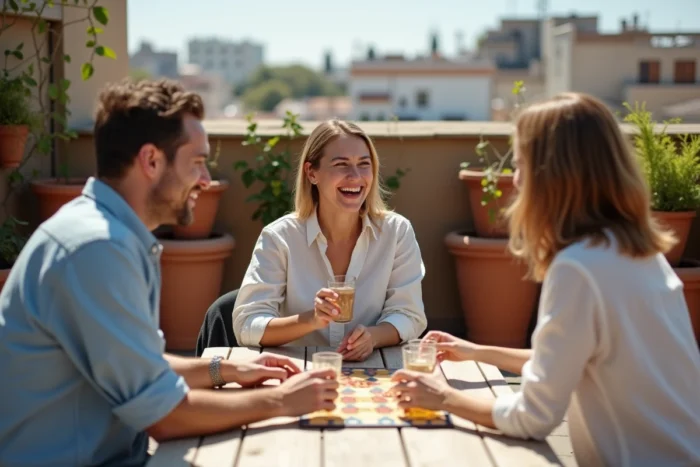
Modern board games have evolved significantly beyond Monopoly. Cooperative games, where the entire team wins or loses together, eliminate direct competition and are suitable for mixed groups (adults and children, experienced players and novices). Game nights organized in playful bars or libraries allow you to try before you buy.
Outdoor collective activities operate on the same principle of active social connection. Improvised pétanque tournaments in a park, team orienteering, frisbee games, or beach volleyball sessions require just a bit of organization and offer moments of shared physical relaxation.
- For evenings with friends: home quizzes, musical blind tests, printable escape games
- For families with children: treasure hunts in the garden or neighborhood, building a fort, collective painting workshop
- For sports groups: group hikes with picnics, archery or kayaking introductions through local clubs
The common element in all these activities: they replace the passive consumption of content with direct interaction. The memory of a memorable game or a collective walk lasts longer than that of a series watched alone on a couch.
Leisure time is only valuable if invested in chosen activities rather than endured. The next available time slot, no matter how short, can be used to test just one new format among those described here. A hobby that restores attention is worth more than three hours of passive screen time.