
The French royal genealogy is not just a list of names on a wall chart. Behind each dynastic transition lies a precise legal mechanism, an agnatic break or a political compromise that reshapes the legitimacy of the throne. Understanding the family tree of the kings of France requires mastering these technical articulations, far beyond a simple chronological catalog.
Salic Law and the Principle of Agnaticity in French Royal Succession
The French monarchy is based on a legal foundation that we refer to as the fundamental laws of the kingdom. Among them, the principle of masculinity derived from Salic law is the cornerstone of any serious genealogical reading.
This principle does not appear in a single constitutional text. It has been built through practice, consolidated over major succession crises. The first test occurs with the death of the three sons of Philip IV the Fair, all of whom died without a direct male heir between 1314 and 1328.
The Valois branch then ascends to the throne not by close blood relation, but by excluding women and their descendants from the line of succession. Philip of Valois prevails over Edward III of England, who is, after all, the grandson of Philip the Fair through his mother. This precedent firmly establishes the strict agnatic doctrine.
Agnaticity implies that only male lineage counts. A descendant through females, even closer in degree, is excluded. This mechanism explains why the family tree of the kings of France and their descendants presents branches that seem illogical if this rule is ignored. The Bourbons ascend to the throne in 1589 precisely because Henry of Navarre is the agnatic senior of the Capetians, despite being over twenty generations removed from the main trunk.
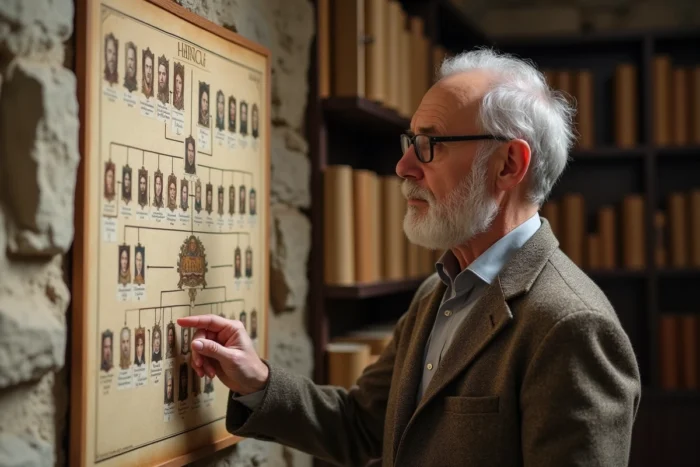
Dynastic Transitions Between Capetians, Valois, and Bourbons
Speaking of “different dynasties” is a misleading shortcut. Valois and Bourbons are junior branches of the Capetians, not distinct families. The agnatic continuity is never broken between 987 and 1792.
The Transition from Direct Capetians to Valois in 1328
Charles IV dies without a son. The peers of the realm dismiss the English candidacy and choose Philip of Valois, grandson of Philip III through the male line. Legitimacy rests on two arguments: agnatic custom and the unavailability of the crown, which prohibits it from being transmitted through women, even indirectly.
The Transition from Valois to Bourbons in 1589
Henry III, the last Valois, is assassinated without heirs. Henry of Navarre, head of the House of Bourbon, is his closest agnatic relative. The difficulty here is not genealogical but confessional: Henry is Protestant. His conversion in 1593 removes the religious obstacle, but the dynastic right already granted him the crown.
These transitions illustrate a point that simplified trees obscure: the crown follows the agnatic line uninterrupted for eight centuries. The distinction between Capetians/Valois/Bourbons is a historical convenience, not a blood rupture.
Current Descendants of the Kings of France and Legitimacy Disputes
Two branches currently claim the Capetian dynastic heritage, and their rivalry is based on divergent interpretations of succession law.
- The Orléanist branch, represented by the Count of Paris, descends from Louis-Philippe I. It bases its legitimacy on the accession to the throne in 1830 and on the principle of French nationality of the claimants.
- The legitimist branch recognizes the Duke of Anjou, the agnatic senior of the Bourbons through the Spanish line. Its legitimacy rests on the strict application of agnaticity, regardless of the renunciations in the Treaty of Utrecht of 1713.
- The Treaty of Utrecht stipulated that the Bourbons of Spain renounce the crown of France. Legitimists contest the validity of this renunciation, arguing that the fundamental laws of the kingdom take precedence over an international treaty.
This debate is not anecdotal. It structures the way the family tree of the kings of France is drawn, depending on whether one adopts an Orléanist or legitimist interpretation. The same tree produces two different heirs depending on the law applied.

DNA Tests and Royal Genealogy: A Restrictive French Legal Framework
Genetic genealogy has transformed ancestry research in Anglo-Saxon countries. In France, the situation remains stalled. A proposed law to legalize DNA tests for genealogical purposes has not been examined by the National Assembly, maintaining a framework where these tests remain prohibited outside judicial proceedings.
This restriction has direct consequences for anyone wishing to prove descent from a royal lineage. Without DNA, proof relies exclusively on written records: parish registers, notarial acts, marriage contracts.
However, the law of December 21, 2018, has relaxed access to civil status records by reducing communication delays. We observe that this development facilitates the work of genealogists on post-revolutionary lineages, but changes nothing for earlier periods where only ecclesiastical and seigneurial records remain.
Proving Royal Descent Without DNA
The process requires tracing back generation by generation with original documents. Documentary gaps increase as one goes further back in time. Before the 16th century, only noble families have documented lineages in a continuous manner.
For others, the statistical probability of royal ancestry is very high over the long term, but individual proof remains inaccessible without a complete documentary chain. Thus, French royal genealogy is read at two levels: that of the documented branches of the dynastic tree, and that of the millions of anonymous descendants that the archives do not allow to be formally linked to the Capetian trunk.