
Four cubic meters: the figure seems abstract until it is compared to real objects. How many moving boxes fit into a volume of 4 m³? Does a two-seater sofa fit, and if so, what margin is left? This article precisely measures what a space of 4 m³ can absorb by comparing storage box configurations, utility trucks, and common furniture combinations.
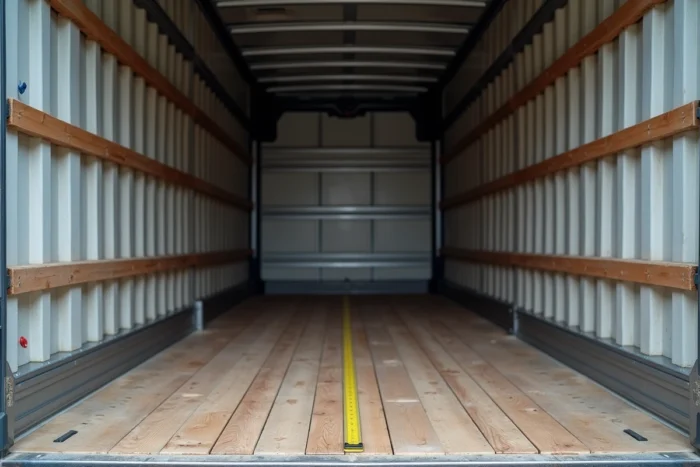
Physical dimensions of a 4 m³ box or utility vehicle
A volume of 4 m³ does not translate to a single geometry. The shape of the container radically changes what can be stored inside, as the usable height and the width of the opening vary from one format to another.
| Container | Indicative Length | Indicative Width | Indicative Height | Usable Volume |
|---|---|---|---|---|
| Storage box (locker) | 2 m | 1 m | 2 m | 4 m³ |
| Furniture storage box (low cell) | 1.5 m | 1.5 m | 1.8 m | approximately 4 m³ |
| Small utility vehicle (Kangoo L1H1 type) | 1.7 m | 1.2 m | 1.1 m | approximately 3 to 4 m³ |
The difference between a vertical storage box (2 m high) and a compact utility vehicle is striking. The ceiling height determines the number of stackable layers, and it is what can gain or lose a third of the actual capacity.
To understand the dimensions and volume of a 4m³, one must reason in terms of floor area multiplied by the stacking height that your items can tolerate. A standard moving box can support three or four levels of load, while a lampshade can support none.
Actual volume of common furniture against the 4 m³ limit
Moving guides assign a theoretical volume to each piece of furniture. The problem is that these volumes do not take shape into account: a double mattress occupies a low rectangular volume, but its length blocks an entire side of the box. A bicycle, on the other hand, takes up little floor space but a lot of height.
Furniture that fits easily
- A standard desk (approximately 0.5 m³), along with its office chair (approximately 0.3 m³), leaves over 3 m³ available – more than enough to add about twenty moving boxes.
- A washing machine (around 0.3 to 0.4 m³) combined with a small refrigerator occupies a quarter of the total volume, provided these appliances are placed at the back of the box.
- A batch of ten to fifteen standard boxes (each representing about 0.06 m³) occupies less than one cubic meter when stacked properly.
Furniture that quickly saturates the space
A classic two-seater sofa weighs between 0.8 and 1.2 m³ depending on its shape. Add a double mattress (about 0.7 m³ when flat) and these two pieces alone consume nearly half of a 4 m³. The remaining volume is enough for a few boxes, but not for a wardrobe.
A two-door wardrobe often represents 0.8 to 1 m³, and its depth of 60 cm reduces lateral storage options. Combining it with a sofa and a mattress usually exceeds 4 m³, unless the wardrobe is disassembled flat.
Concrete loading scenarios in 4 m³
Rather than listing abstract volumes, three realistic configurations allow us to visualize what fits – and what stays outside.
Student studio scenario: a desk, a chair, a small single mattress, five boxes of books, and a few bags of clothes. The whole fits into 2.5 to 3 m³, leaving a comfortable margin. This type of loading corresponds to the most frequent need for a box of this size.
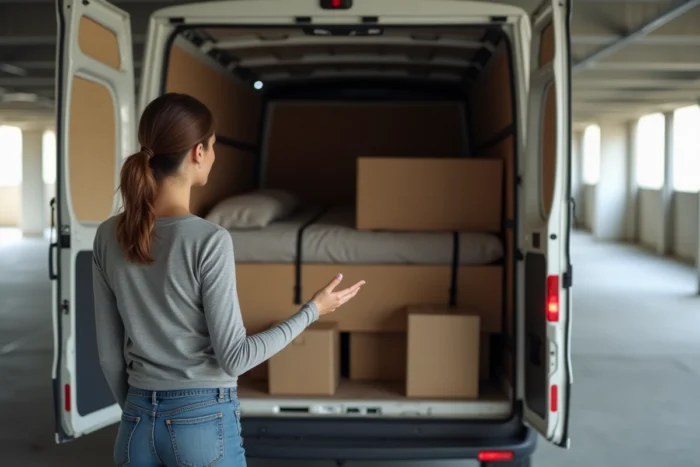
Partial moving scenario: a two-seater sofa, a low TV unit, a folding table, and ten boxes. We approach 3.5 m³. The margin is slim, and it all depends on the loading order: the sofa goes in last, standing if height allows, to avoid crushing the boxes.
Professional stock scenario: boxes of homogeneous goods (clothing, accessories, spare parts). Because the shapes are regular, loading identical boxes utilizes up to 90% of the theoretical volume. This is where the 4 m³ proves to be the most efficient. The French self-storage network now has hundreds of sites offering small cells designed for this type of micro-logistics.
Actual filling rate of a 4 m³: why we lose volume
Claiming that a 4 m³ box contains 4 m³ of items would be misleading. Several factors reduce the usable volume.
Furniture is not made of cubes. An armchair, a bicycle, or a vacuum cleaner leave air pockets that are impossible to fill. In practice, the actual filling rate varies between 60 and 80% for mixed household furniture. For a volume of 4 m³, this represents a usable space between 2.4 and 3.2 m³.
Access to items also plays a role. In a storage box rented for several months, keeping a small aisle to reach the back is recommended as soon as the floor area exceeds one square meter. This aisle consumes volume, but it prevents the need to empty everything during each visit.
In contrast, in a utility vehicle, the constraint is different: there is no need for an aisle, but the loading height is often lower than that of a box, which limits stacking.
4 m³ storage box or 4 m³ utility vehicle: which option for which use
The choice between renting a box and renting a utility vehicle depends on the duration and frequency of access.
- A storage box is suitable for long-term deposit (several weeks to several months). The ceiling height allows for more stacking, and access is generally possible without time constraints in most centers.
- A small utility vehicle of 3 to 4 m³ meets a one-time transport need. Its reduced height limits stacking, but it allows moving the contents of a studio in a single trip.
- For regular professional use (restocking, buffer stock), the box wins: it functions as a nearby warehouse accessible on demand, without needing a vehicle.
The volume of 4 m³ lies at the boundary between a spare locker and a true storage unit. For the contents of a fully furnished studio with appliances, it is often necessary to move up to a larger size. For targeted storage (seasonal clothing, sports equipment, professional archives), 4 m³ meets the need without paying for unnecessary space.