An online postcard is a physical piece of mail, printed and distributed by a postal operator, whose creation and ordering are done entirely from a screen. The process replaces the purchase of illustrated cardboard, handwritten writing, and a trip to the post office with a digital interface that manages personalization, printing, and postage in one operation.
Digital postcard or online postcard: two different objects
Confusion is common. A digital postcard (e-card) remains an image file sent via email or messaging. It has no physical existence and disappears in the flow of notifications.
An online postcard, on the other hand, produces a paper object. The recipient finds it in their mailbox, touches it, places it on a piece of furniture. The difference lies in the final medium, not the ordering channel.
This distinction matters because the emotional impact of tangible mail is well documented: in a context where traditional mail has declined by about half since 2019, receiving a physical card is out of the ordinary. Online postcard services precisely exploit this contrast between the rarity of paper mail and the emotional weight it retains. It is indeed possible to send an online postcard with Index Site to discover this type of service without having to go out.
Photo and message personalization: what sending platforms allow
Most services operate according to the same technical sequence. Understanding each step helps avoid unpleasant surprises upon receipt.
Importing and processing the photo
The personalized postcard relies on a photo imported from the phone, a cloud gallery, or a local folder. The file is cropped to the size of the card (often close to 10 x 15 cm) and then adjusted in resolution for printing.
An image that is too compressed will result in a blurry print. Photos taken directly from the smartphone’s camera, without going through a messaging app that reduces quality, provide a much sharper result.
Writing the message
The text is entered in a dedicated area, replicating the classic back of a postcard. Some platforms offer handwritten fonts to simulate writing by hand, while others print in standard typography.
The length of the message is constrained by the physical surface of the cardboard. A few sentences are sufficient. A short and personal text holds more value than a generic block of text.
Choice of paper and format
Depending on the services, the weight of the cardboard and the finish (matte, glossy, varnished) vary. A paper with a sufficiently dense weight ensures the expected rigidity of a real postcard. The most common formats remain the classic rectangular and square.
Printing, postage, and postal delivery time
Once the order is validated, the platform triggers the printing. On several French services, validation before 5 PM leads to printing and deposit at the sorting center on the same day.
Postage is included in the price. The service buys the stamp, affixes or prints the recipient’s address, and deposits the mail into the postal system. The delivery time then depends on the postal operator of the destination country.
- In mainland France, delivery generally takes a few working days after deposit at the sorting center.
- To Europe, the time extends according to bilateral postal agreements, often around a week.
- To the rest of the world, delivery can take significantly longer, with no tracking guarantee once the mail leaves the national network.
The unit price covers printing, cardboard, and postal sending. Comparing prices between platforms makes sense, but the decisive criterion remains the quality of printing and the reliability of postal deposit, not the cost of the stamp (identical for the same weight and destination).
Online postcard from a mobile: constraints and advantages while traveling
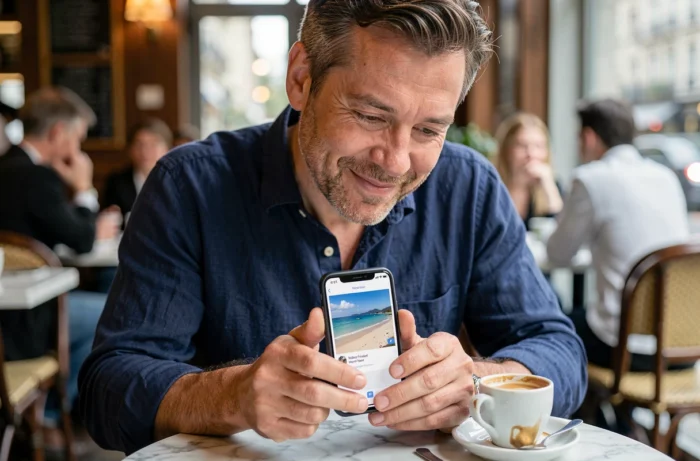
Sending a vacation postcard from your phone eliminates the need to search for a post office, a card display, and a pen. On a trip abroad, this practical aspect truly changes the usage.
Dedicated mobile apps allow you to take the photo, write the text, and validate the sending in just a few minutes. The card is sent from the country of printing, not from the country where the sender is located. A traveler in Japan who orders through a French service will see their card printed and mailed in France, which shortens the time for a French recipient.
The main constraint remains the internet connection. Without a stable network, uploading the photo fails or produces a degraded file. Preparing the card on Wi-Fi, at the hotel, avoids this problem.
Online postcards sent to nursing homes: an expanding social use
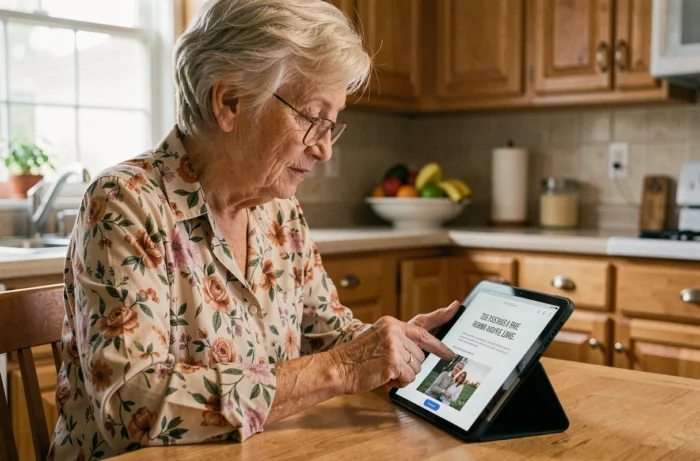
In 2026, the Fizzer app launched the operation “From Smile to Card” in several French nursing homes. The principle: strangers send personalized cards (photos, messages) to residents to break isolation.
Local reports describe collective sessions of opening cards, with a positive impact on morale and interactions among residents. The cards allow, according to collected testimonies, to “travel by proxy” for people who can no longer move.
This use case illustrates that the online postcard goes beyond the context of vacations or birthdays. It becomes a tool for social connection at a distance, particularly suited for people who are less connected to digital technology but very receptive to physical mail.
Concrete criteria for choosing an online postcard service
- Print quality: check the weight of the paper and the minimum resolution accepted for photos. A service that accepts low-resolution images without warning will produce blurry cards.
- Postal deposit time: a service that prints and posts on the same day (before a cutoff time) shortens delivery by at least one working day compared to processing within 48 hours.
- Geographical coverage: some services only ship within France, while others cover most countries. Check before ordering for a recipient outside Europe.
- Multi-recipient management: sending the same card to multiple addresses in a single order saves time, especially for grouped holiday mailings.
The paper postcard, ordered online and delivered by mail, remains one of the few physical objects that can be sent to someone without knowing anything other than their address. In a context of global decline in mail, this simplicity gives it a value that digital messages do not replicate.