Heating accounts for about three-quarters of a household’s energy expenses according to ADEME. Reducing this bill requires understanding what distinguishes a high-performance system from aging equipment, and then acting on the right technical levers rather than blindly multiplying small gestures.
COP and efficiency: what really measures the performance of heating
Before comparing equipment, two often-confused concepts need to be clarified. Efficiency expresses the ratio between the energy released as heat and the energy consumed. A recent gas condensing boiler achieves an efficiency of over 90%, meaning that almost all of the burned fuel is converted into useful heat.
The heat pump (PAC) works differently. It burns nothing: it extracts calories from the air, ground, or water, and then transfers them to the heating circuit. Its performance is measured by the coefficient of performance (COP), which can exceed 3. A COP of 3 means that for every 1 kWh of electricity consumed, the PAC delivers 3 kWh of heat.
This fundamental difference explains why, with comparable aid amounts, heat pumps account for nearly two-thirds of the energy savings achieved through MaPrimeRénov’ by gesture, even though they represent only about a quarter of the applications. The COP creates a multiplier effect that the efficiency of a boiler cannot match.
For a deeper understanding of the various high-performance heating systems and their comparative costs, a useful resource is: https://www.chauffage-economique.com/.
Heat pump, wood, condensation: which system really reduces the bill
The choice of an economical heating system depends on the home, the climate zone, and the initial budget. Three systems stand out today for their cost-to-performance ratio.
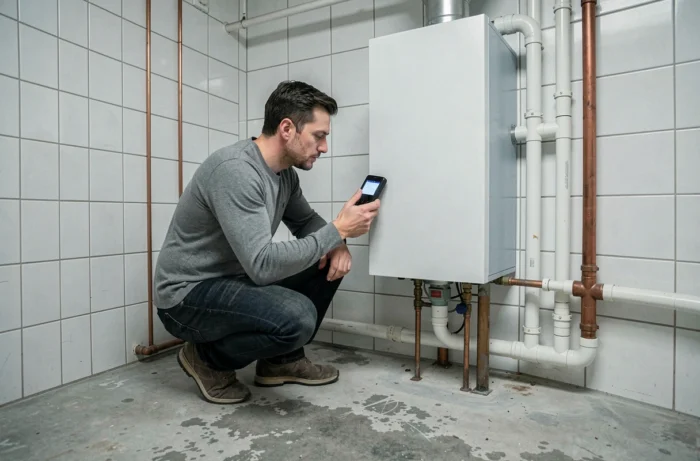
The air-water PAC remains the option that generates the most significant savings on the annual bill. It feeds an existing radiator network or underfloor heating and can also produce domestic hot water. Its installation cost is significant, but current aids (MaPrimeRénov’, CEE) cover a large part depending on the household’s income.
Wood heating (log stove, pellet stove, wood boiler) offers one of the lowest kWh costs on the market. Wood energy remains competitive provided there is storage space and a willingness to handle logs regularly. Pellet stoves automate feeding, but the price of pellets fluctuates more than that of logs.
The gas condensing boiler still holds interest in homes connected to the network, especially when the investment budget is limited. It significantly improves efficiency compared to an old boiler. However, regulations are evolving: the installation of new gas boilers in new buildings is already restricted, and further tightening is expected for 2026-2027.
Insulation and regulation: the two levers that amplify heating savings
Installing a high-performance system in a poorly insulated home is like heating the outside. Thermal insulation determines the efficiency of any equipment, regardless of its COP or nominal efficiency.
Heat losses are concentrated in a few identifiable areas:
- The roof and attics, through which the largest share of heat escapes in an uninsulated single-family home.
- Exterior walls, especially in buildings built before the first thermal regulations.
- Windows and openings, where faulty seals and single glazing create permanent thermal bridges.
Addressing these areas before or simultaneously with the replacement of the heating system allows for more accurate equipment sizing. An oversized PAC in a subsequently insulated home will operate in short cycles, which degrades its lifespan and actual COP.
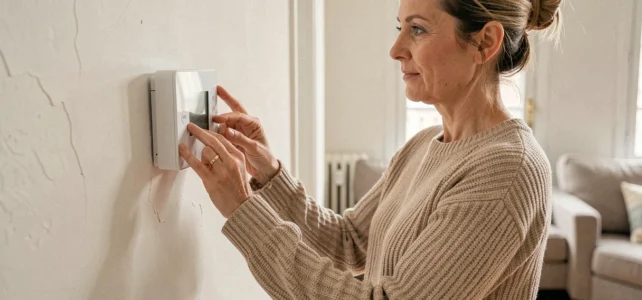
The second lever, often underestimated, is regulation by programmable thermostat. Adjusting the temperature according to room occupancy (19 °C in occupied living areas, 16 to 17 °C at night or when absent) generates measurable savings without altering the building envelope. Connected thermostats add presence detection and remote control, further reducing waste due to forgetfulness.

MaPrimeRénov’ and extensive renovation: the shift in aid in 2024-2025
Public aid programs have shifted towards a model that favors structural renovations rather than isolated gestures. In 2024, about 91,900 homes initiated a major renovation with aid from Anah, an increase of about 30% year-on-year.
At the same time, the number of MaPrimeRénov’ applications for “gesture” renovations (such as replacing a single boiler) halved between 2023 and 2024. This decline is partly explained by a tightening of eligibility conditions.
This shift has a direct consequence on the savings strategy. Combining insulation, ventilation, and heating system changes within the same renovation project grants access to higher aid amounts and produces more sustainable results on the bill. An isolated boiler change, without addressing the envelope, provides limited gains and no longer receives the same level of financial support.
Here are the key steps to structure a renovation project focused on economical heating:
- Conduct an energy audit of the home to identify the main losses and size the work accordingly.
- Prioritize insulating the most energy-loss-prone areas (roof, walls) before choosing the heating system.
- Compare equipment scenarios (PAC, wood, hybrid) by integrating the total cost over ten to fifteen years, not just the purchase price.
- Check eligibility for MaPrimeRénov’ extensive renovation aid, which has more favorable caps than an isolated gesture.
The heating bill rarely decreases through a single spectacular gesture. It is the combination of a high COP system or low-cost fuel, a treated thermal envelope, and fine regulation that produces significant and lasting reductions. Public aids now support this overall logic rather than isolated replacements.