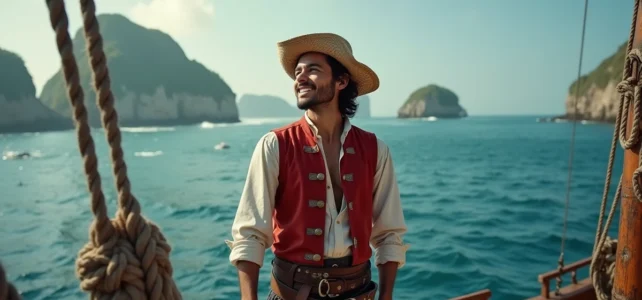
One Piece tells the adventure of Monkey D. Luffy, a young straw hat pirate who sails the most dangerous seas in the world to find a legendary treasure. Since the late 1990s, this manga by Eiichiro Oda has built a universe where every island, every secondary character, and every line of dialogue can resurface hundreds of chapters later.
What initially seems like a pirate story ultimately questions freedom, power, and collective memory.
The Straw Hat Crew as a Model of Alternative Organization
Have you ever noticed that Luffy’s crew does not operate like an army or a business at all? There is no rigid chain of command. Each member has their own skill, and decisions are often made in chaos, based on trust rather than authority.
An analysis published by Sud Ouest draws parallels between this functioning and alternatives to traditional business: cooperatives, horizontal collectives, liberated organizations. The World Government in One Piece represents the classic hierarchical structure, with its opaque rules and centralized control. Luffy’s crew embodies the exact opposite.
What makes this reading relevant is that Oda never presents this model as perfect. The Straw Hats fail, argue, and separate. Their strength lies in a bond of trust rebuilt with each narrative arc. To discover the maritime epic of One Piece in detail, one must accept that this story speaks as much about human relationships as it does about battles.

One Piece Pirate Symbols and Their Current Political Resonance
Can a manga flag become a tool of protest in real life? In the Dominican Republic, the Jolly Roger with a straw hat appeared in December 2025 during a hearing in the Senasa case. It then became a symbol of rejection of impunity and demand for institutional reforms.
International media now describe this flag as an emblem of Generation Z against corruption and authoritarianism. Mobilizations occur through social media, in a decentralized manner, without a single leader. The parallel with the manga universe is striking: in One Piece, pirates who refuse the established order also do not follow a central command.
Why this flag and not another?
Luffy’s straw hat conveys a simple idea: individual freedom takes precedence over blind obedience. It is an accessible, visual message that requires no political affiliation to be understood. The Jolly Roger functions as a universal language for generations who grew up with the manga.
Oda has always infused his arcs with political themes. The Alabasta arc deals with the manipulation of a government by an infiltrated agent. The Dressrosa arc exposes a dictator who literally erases people from collective memory. These narratives resonate directly in real contexts, which explains why the symbols of the series transcend the realm of fiction.
Narrative Construction of One Piece: The Long Thread Technique
Most popular mangas operate through relatively self-contained arcs. One Piece employs a different method: every detail planted can become a major narrative element years later. A character briefly encountered in one arc returns with a decisive role several hundred chapters later. An apparently innocuous phrase turns out to be a crucial clue.

This long thread technique relies on a planning that few manga authors maintain over such an extended period. Oda does not just tell a linear adventure. He constructs a network of underground connections between arcs, characters, and locations.
Three Narrative Mechanisms that Structure the Universe
- The Poneglyphs are indestructible stone tablets scattered throughout the world. They contain the history erased by the World Government, and their deciphering guides the crew toward the final treasure. Each Poneglyph discovered adds a piece to the overall puzzle.
- The Devil Fruits grant unique powers to those who consume them, but in exchange for the ability to swim. This symbolic sacrifice anchors each battle in an initial choice: to gain power at the cost of a permanent vulnerability to the sea itself.
- The bounty system assigned by the Navy functions as a narrative barometer. A character’s bounty reflects not only their strength but also the level of threat they represent to the established order. An archaeologist capable of reading the forbidden history may have a higher bounty than a formidable fighter.
These three mechanisms are not mere narrative gadgets. They structure the progression of the story and provide the reader with reference points to measure the journey toward the One Piece.
Journey and Geography in One Piece: Each Island Poses a Question
The Grand Line, the main maritime route of the series, traverses unpredictable climatic zones. Each island encountered by the crew has its own rules, culture, and conflict. Skypiea floats in the sky and questions the notion of territorial ownership. Water Seven is a floating city where rising waters threaten the inhabitants.
Oda uses geography as a narrative tool. The isolation of certain islands explains why injustices can persist without the rest of the world knowing about them. The World Government exploits this isolation to control information. Luffy’s journey consists as much of crossing the ocean as it does of breaking these barriers.
This construction makes One Piece a narrative where the world itself is a character. The seas, currents, and shifting islands actively participate in the plot. The reader does not just follow a crew: they explore a map that gradually unfolds, arc by arc, with the certainty that each new territory hides a part of the truth about the entire world.