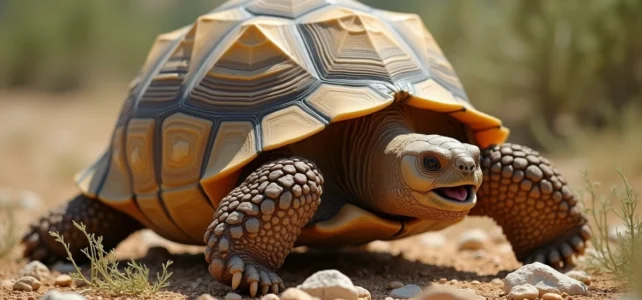
Your male Hermann’s tortoise has been relentlessly chasing, biting, or bumping into his companion since the return of warm days. This sometimes brutal behavior is understandably concerning. In the vast majority of cases, this aggression reflects a specific biological mechanism related to sexual maturity, amplified by inadequate captivity conditions. Understanding what triggers these behaviors allows for action on the right causes, without waiting for the female to suffer serious injuries.
Sexual maturity and underestimated age: the primary cause of aggression in male Hermann’s tortoises
You may have noticed that your previously placid male has started to chase and bite the legs or neck of the female? This shift almost always corresponds to the onset of sexual maturity.
In Hermann’s tortoises, this maturity does not depend on a fixed age but on the size and development of the animal. A male can exhibit courtship displays while his owner still considers him a juvenile. The actual age of captive tortoises is often underestimated, leading many owners to interpret typical adult male behavior as abnormal.
The courtship behavior includes a recognizable sequence: the male circles around the female, bumps his shell against hers, bites her limbs, and attempts to mount her. These actions are not acts of malice. It is a hormonal program that activates in spring, with the lengthening of days and rising temperatures.
To accurately assess the situation, it is better to think in terms of stages of maturity (juvenile, subadult, adult) rather than presumed age. A healthy adult male will potentially be persistent every year, without this constituting a behavioral disorder. To understand an aggressive male Hermann’s tortoise on Animaloo, this distinction between natural behavior and pathology remains the starting point.

Living space and male-female ratio: two parameters that change everything
The same male placed in an enclosure of a few square meters or in a garden of several dozen square meters will not behave the same way. In captivity, proximity concentrates interactions and prevents the female from escaping the advances.
The ratio of males to females
A single male cohabiting with a single female creates the most problematic configuration. The male concentrates all his reproductive energy on a single partner, who then endures constant solicitations. Chronic stress can lead her to refuse to eat, experience general weakening, and suffer injuries to her neck, limbs, and the edge of her shell.
Feedback from specialized facilities and breeder groups converge on one point: maintaining at least two, or even three females per male helps to dilute the pressure. If this configuration remains impossible, physical separation becomes the only reliable option.
Enclosure design
A well-designed space offers areas for visual breaks. Mounds of earth, flat stones, and clumps of dense vegetation allow the female to escape the male’s line of sight. Without these obstacles, even a large enclosure remains an open pursuit ground.
- Provide multiple shelter areas throughout the enclosure, not just a single refuge point
- Create low plant barriers (lavender, rosemary, dense grasses) to break lines of sight
- Place feeding and watering points in separate locations to avoid confrontations at the same spot
Temporary or permanent separation: when and how to separate your tortoises
Separating the male from the female remains the most effective solution when aggressions cause visible injuries or prolonged stress. This separation is not cruel. In the wild, Hermann’s tortoises do not live in permanent pairs. They cross paths occasionally for reproduction and then each goes their own way.
In practice, two approaches exist depending on your configuration.
Seasonal separation
The peak of aggression occurs in spring, just after emerging from hibernation. This is when the male’s hormones are at their highest. Isolating the male from spring to early summer often suffices to protect the female during the most intense phase.
Supervised short-term contacts can then be reintroduced if reproduction is desired, monitoring that the female does not show signs of fleeing or retreating.
Permanently separation
If your enclosure is too small to provide real distance, or if the male harasses the female even in summer and autumn, permanent separation is necessary. Two distinct enclosures, even modest ones, are better than a single shared space under constant tension. A male alone in a well-designed enclosure does not suffer from loneliness: terrestrial tortoises are solitary animals by nature.

Injuries and warning signs: when to consult an exotic pet veterinarian
Repeated bites on the female’s legs, neck, or tail can exceed the superficial stage. Open wounds, a damaged shell at the edges, or an animal that remains huddled in a corner require a consultation with a veterinarian specialized in exotic pets (NAC).
- Bite marks with bleeding or swelling should be cleaned quickly and evaluated by a professional
- A prolonged refusal to eat in the female may signal stress that compromises her health
- A male that no longer eats or remains huddled may also suffer from a health issue distinct from hormonal aggression
- Frequent flipping of the female (onto her back) indicates a dangerous intensity of pursuit
The exotic pet veterinarian can check the general condition of both animals, treat injuries, and confirm whether the behavior is indeed related to reproductive display or another factor (pain, parasites, illness).
The aggression of a male Hermann in captivity is almost never an issue of individual temperament. It is an animal acting according to what biology dictates, in a space that does not allow it to do so without harming its partner. Adjusting the ratio, space, and cohabitation schedule resolves the vast majority of situations, without medication or heavy intervention.