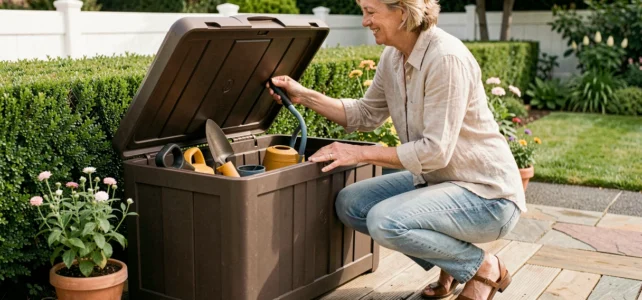
A garden chest is an outdoor storage box, typically made of resin, wood, or metal, designed to store cushions, tools, or pool accessories protected from the elements. Choosing the right model at Brico Dépôt requires first clarifying what you expect from this piece of furniture: useful volume, shock resistance, compatibility with a narrow balcony or a large terrace.
Lockable garden chest: a frequently overlooked insurability criterion
Most selection guides compare materials and capacity in liters. Few address the issue of home insurance, which conditions coverage in case of theft or weather-related damage.
Home insurance policies generally only cover the theft of garden equipment if it is secured to the ground or locked in a closed room. A chest simply placed on the terrace, without a lock or anchoring, risks falling outside the coverage perimeter.
To meet this requirement, three points must be checked before purchase: the presence of an integrated locking system (padlock or cylinder lock), the possibility of securing the chest to the ground or wall with brackets, and the robustness of the structure (thick walls made of reinforced resin or metal). Finding the ideal Brico Dépôt garden chest also involves this verification, which transforms a simple storage unit into equipment covered by your insurer.
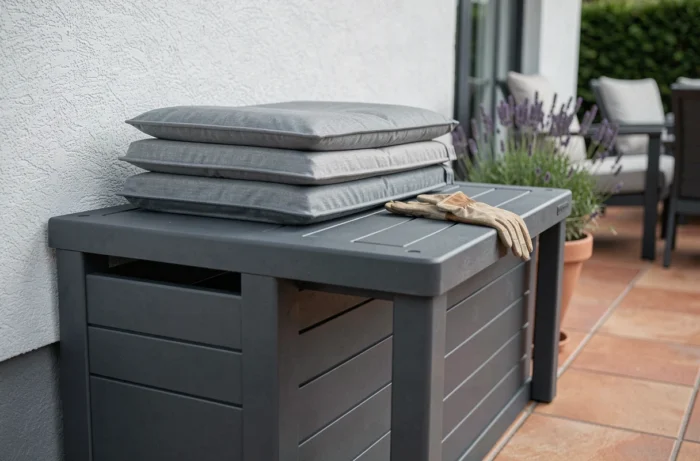
Resin, wood, or metal: which material for which outdoor chest use
The material determines the durability, weight, and maintenance of the chest. Each option corresponds to a specific usage profile.
Resin: the lightweight choice for balconies and small terraces
Resin (polypropylene or polyethylene) is the most common material in entry-level garden chests. It does not rust, does not rot, and can be cleaned with a water jet. Its lightweight allows for easy movement of the chest, which is suitable for urban balconies and terraces where space is reorganized according to the seasons.
The downside: standard resin ages under UV rays. After a few summers, the surface may whiten or become brittle if the chest is exposed to full sun without protection. Woven resin models mimic rattan and age better, but their price increases accordingly.
Wood: natural aesthetics, regular maintenance
A wooden chest (treated pine, acacia, or eucalyptus) blends into a planted garden without clashing. Wood offers good mechanical resistance and natural ventilation, useful for storing cushions without the risk of mold.
Maintenance remains the weak point. A stain or saturator must be applied every year or every two years to maintain the wood’s waterproofing. Without this maintenance, the chest grays, warps, and eventually cracks.
Metal: maximum strength and security
Galvanized steel or aluminum withstands impacts, attempted break-ins, and severe weather. It is the material that best meets the insurability requirements mentioned earlier. However, metal conducts heat: a metal chest in full sun can overheat and damage certain stored items (candles, pool chemicals).
Volume and dimensions of the garden chest: adapting storage to available space
The volume displayed in liters is not enough to make a choice. Two chests of the same capacity can have very different dimensions, and one may not fit in your available space.
- For a balcony or small terrace, a chest of less than 300 liters, narrow and elongated, serves as an extra bench while storing cushions and tablecloths.
- For a spacious terrace, a chest of 300 to 500 liters accommodates folding garden furniture, outdoor games, and barbecue accessories.
- For a garden with a pool, a chest of more than 500 liters stores floats, towels, maintenance products, and a cover tarp. Its depth requires checking that the lid opens fully without hitting a wall.
Before ordering, measure the intended location while considering the lid’s opening margin (often equivalent to the chest’s depth). A model equipped with hydraulic struts makes it easy to open with one hand and prevents the lid from falling on fingers.
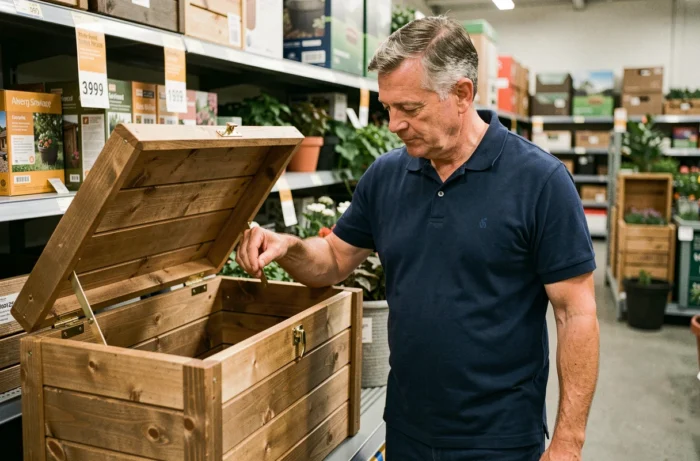
Garden chest as the primary storage solution: an alternative to sheds
The garden chest is no longer just a supplement to a shed. In urban homes with a terrace or balcony, it becomes the primary outdoor storage solution, where a garden shed would be impossible to install due to lack of ground space or condominium permission.
This evolution changes the selection criteria. A chest used as primary storage must offer total waterproofing (gaskets around the lid, raised bottom to prevent moisture rise) and sufficient capacity to store all seasonal furniture. Brico Dépôt models made of resin with double walls and ventilated bottoms meet this need without requiring a concrete slab or prior work declaration.
One last point deserves attention: the empty weight of the chest influences its stability in high winds. A lightweight resin chest, placed on an exposed balcony, can tip over if empty. Opt for a model with integrated anchoring points or weigh it down with patio slabs if you cannot secure it to the ground.