
Your dog trembles during thunderstorms, gets agitated as soon as you take your keys, or destroys objects in your absence. These reactions reflect a real emotional distress. Bach flowers for dogs are part of the gentle approaches used by some owners to address these issues. Before adopting them, it’s better to understand what they are, what they can provide, and where their limits lie.
Bach Flowers and Canine Behavior: The Mechanism Behind the Drops
Bach flowers are based on a simple principle. Wildflowers are macerated in spring water, either through sun exposure (solarization) or by boiling. The resulting liquid is then diluted and preserved in alcohol. Each elixir corresponds, according to Dr. Edward Bach’s method, to a specific emotional state.
For dogs, the elixirs are chosen based on the observed behavior. A fearful dog in the presence of strangers will not receive the same mixture as a hyperactive dog or one that is downcast after a move. The choice of flower depends on the dog’s emotional profile, not on its physical symptoms.
Specifically, the essences are absorbed through the oral mucosa. They can be placed on the gums, in the water bowl, or on a treat. Administration remains easy, even with a wary animal. Specialized professionals like Cani Essence assist owners in choosing and using these elixirs suitable for animals.
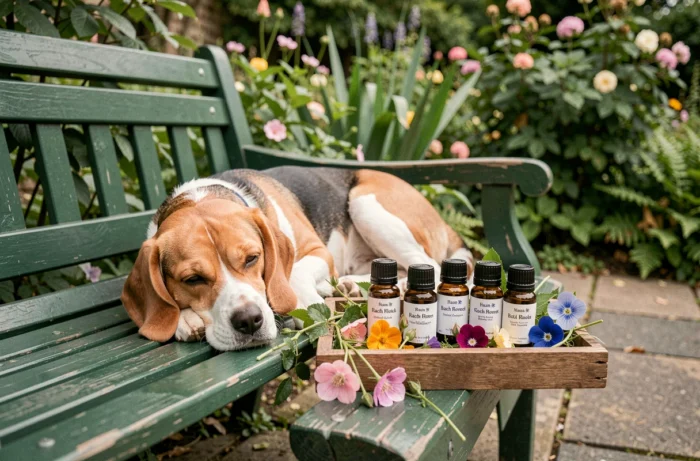
Alcohol in Floral Elixirs for Dogs: A Point Not to Overlook
Have you ever noticed the mention of “brandy” or “cognac” on a bottle of Bach flowers? It’s not insignificant. Alcohol serves as a preservative in most preparations. For an adult human, a few drops diluted in a glass of water pose no problem. For a small dog, however, the question deserves consideration.
A dog’s liver metabolizes alcohol much less efficiently than that of a human. At very low doses (two to four drops in a bowl), the toxic risk remains negligible according to practitioners in animal naturopathy. However, prolonged use at high doses on a small dog could pose a concern.
Two practical precautions reduce this risk:
- Prefer alcohol-free preparations, preserved in apple cider vinegar or vegetable glycerin, available from certain specialized manufacturers.
- Always dilute the drops in the water bowl rather than administering them pure on the gums.
- Adjust the number of drops according to the animal’s weight, starting with the lowest recommended dose on the bottle.
Bach Flowers for Stressed Dogs: What Concrete Situations
Owners turn to these elixirs in well-identified contexts. Here are the most common, along with the flowers generally associated.
Mimulus is often recommended for identifiable fears: fear of the veterinarian, construction noise, another animal. The dog backs away, trembles, or hides. The Mimulus elixir specifically targets this type of focused fear.
For separation anxiety (destruction, barking as soon as the owner leaves), practitioners tend to recommend Chicory or Red Chestnut. These two flowers correspond to excessive attachment and worry related to the absence of the human reference.
The Rescue blend, the most well-known, combines five flowers. It is used in acute crisis situations: a visit to the veterinarian, a car ride, fireworks. Rescue acts as an emergency support, not as a long-term treatment.
A dog that is downcast after surgery or sterilization may receive elixirs like Olive (exhaustion) or Walnut (adaptation to change). These post-traumatic situations represent a common use in animal naturopathy.
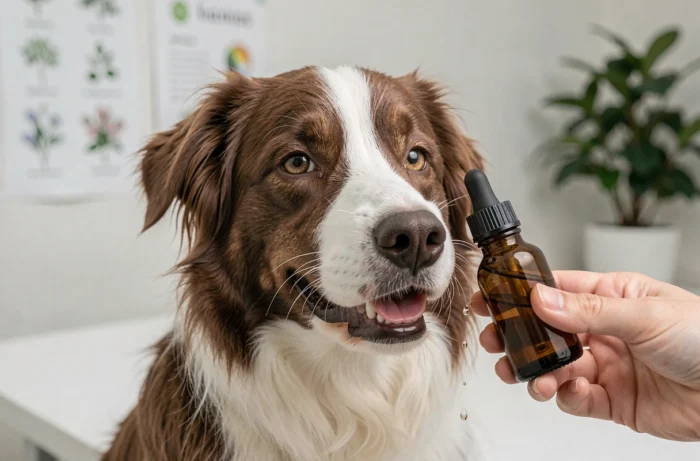
Effectiveness of Bach Flowers in Dogs: What Recent Comparisons Say
This is the topic that most animal naturopathy sites avoid. Bach flowers have not, to date, demonstrated effectiveness beyond a placebo effect in the available clinical studies.
Recent comparisons rank various anti-stress solutions for dogs by level of evidence. Pheromones and alpha-casozepine have documented clinical studies, with observed effectiveness in the majority of cases of moderate stress. The Rescue blend, on the other hand, is categorized among options with low scientific evidence.
In dogs, the concept of placebo effect works differently than in humans. The animal does not “believe” in the remedy. However, the administration ritual (owner’s attention, physical contact, calm moment) can indirectly modify the dog’s emotional state. The owner, reassured by the use of the product, adopts a calmer behavior, which the dog perceives.
This observation does not disqualify Bach flowers. They do not present known side effects at usual doses. They can be integrated into a holistic approach, provided that a behavioral veterinary consultation is not delayed when the issue is severe.
What Bach Flowers Do Not Replace
A dog that bites out of fear, self-mutilates, or refuses to eat for several days requires a veterinary diagnosis. Bach flowers are not intended to treat a deep behavioral disorder or an organic pathology disguised as an emotional problem.
Prudence consists of using floral elixirs as a complement, never as a substitute for professional advice. A veterinary behaviorist can determine whether the problem requires medication, a desensitization protocol, or if gentle support is sufficient.
Bach flowers offer an accessible entry point to the emotional well-being of dogs. Their ease of use and the absence of undesirable effects make them a tool appreciated by many owners. Keeping a clear perspective on their level of evidence allows them to be used in their rightful place, without expecting from them what they cannot provide.