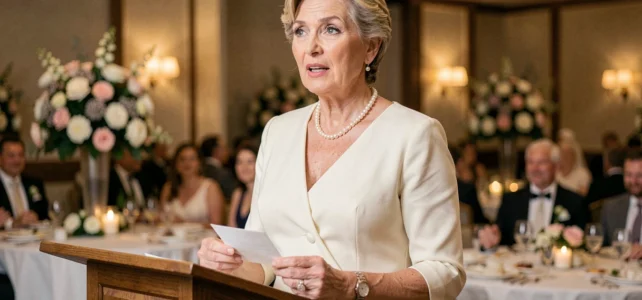
The groom’s mother’s speech is not a toast. It is a speech embedded in the ceremonial framework, just like the officiant’s or the witnesses’ interventions. With the rise of structured secular ceremonies, this segment has gained a formal status that alters its substantive and formal constraints.
Secular Ceremony and Codified Place of the Maternal Speech
The generalization of secular ceremonies has transformed parental speeches. It is no longer an improvised moment at dessert, but a segment planned in the outline drafted by the officiant. The groom’s mother is assigned a specific time slot, often placed after the vows and before the exchange of rings or the symbolic ritual.
This framing imposes a calibrated duration (rarely beyond four to five minutes) and coherence with the overall narrative thread of the ceremony. We observe that professional officiants now request to review the text in advance to check the fluidity of transitions between speakers.
The continuous increase in the number of weddings in France in recent years, following delays related to Covid, has amplified this phenomenon. The return to large family gatherings is accompanied by more ritualized ceremonies, where the groom’s mother’s speech to her son serves as a marker of the reconfiguration of family ties around the couple.
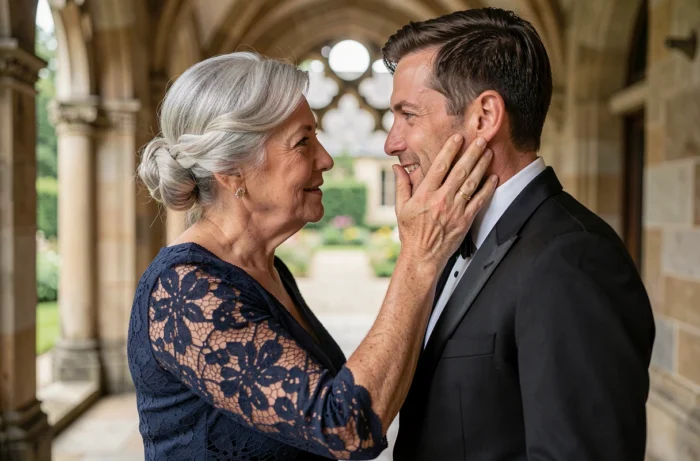
Direct Address to the Son and Managing the Dual Audience
The technical difficulty of the maternal speech lies in its dual audience: the son and the assembly. The mother speaks to her child but addresses people who do not share the same intimacy. This gap creates a constant risk of discomfort if the tone shifts towards private confessions.
We recommend structuring the text by alternating passages in the second person (addressed to the groom) and passages in the third person (which place the son within a shareable narrative). This alternation avoids emotional closeness while preserving the emotion of direct address.
Emotional Register and Saturation Threshold
A maternal speech that strings together childhood memories without filter causes what officiants call emotional saturation. The assembly disengages after the second anecdote if no change in tone occurs. Alternating anecdotes, light humor, and projections towards the couple maintains attention and gives the text a sustainable rhythm for the mother herself.
The common trap is to accumulate touching scenes from early childhood. The groom is no longer a child. The speech gains strength when it acknowledges the adult he has become and explicitly welcomes the person he has chosen.
Welcoming the Daughter-in-law or Partner in the Speech
One of the most underestimated points concerns the mention of the spouse. Omitting the daughter-in-law or partner in a speech centered on the son creates a noticeable imbalance for the assembly. Naming the partner and addressing them with at least one personalized sentence transforms the speech from a parental monologue into a gesture of welcome.
The wording matters. A simple “welcome to the family” remains generic. Mentioning an observed character trait, a shared moment, or a concrete quality of the partner gives substance to this welcome and shows that the relationship exists beyond the bond with the son.
What the Speech Says About Family Posture
The groom’s mother’s speech functions as a public declaration of the family dynamic. The assembly reads, consciously or unconsciously, the place that the family of origin grants to the new couple. A text that only speaks of the family past without projecting the couple into the future sends a signal of retention.
A good maternal speech explicitly transitions from the mother-son bond to the marital bond, without this transition being experienced as a loss. It is this shift that gives the moment its real emotional weight.

Text Construction: Method and Common Mistakes
Writing the maternal wedding speech benefits from following a three-movement structure: anchoring (a memory or trait of the son), pivot (the meeting with the partner or the evolution towards adulthood), opening (a wish or a word directed towards the couple). This breakdown is not rigid, but it avoids the two usual pitfalls: the chronological catalog and the private love letter read in public.
- Limit anecdotes to two, chosen for what they reveal about the son’s character rather than for their sentimental value alone
- Include a direct address to the partner that goes beyond a polite formula and names a concrete element of the relationship
- End with a sentence directed towards the couple’s future, not with a nostalgic return to childhood
The most common mistake we observe is textual overload. A maternal speech for a secular ceremony rarely exceeds five minutes without losing the assembly’s attention. A text of 400 to 600 words adequately covers the three movements described above.
Oral Preparation and Stress Management
Writing the text is not enough. The groom’s mother who reads her speech for the first time on the big day exposes herself to emotional disconnection during the reading. We recommend at least three readings aloud before the ceremony, one of which should be in front of a close person, to identify the passages where the voice may break.
- Print the text in at least 14-point font, with wide line spacing and visual markers (underlined keywords) to help regain the thread after a pause
- Have a glass of water within reach, which also provides a natural excuse to take a breath
- Accept visible emotion: a silence of a few seconds touches the assembly more than a mechanical reading without hiccups
A successful maternal speech is one that the couple still quotes years later. It does not depend on the literary perfection of the text, but on the accuracy of the positioning: a mother speaking to an adult, acknowledging their choice, and opening the door to the couple they form.