In France, the electric scooter is no longer just a leisure gadget. The year 2025 marked a turning point with 79 deaths among users of EDPM according to the National Interministerial Observatory for Road Safety (ONISR), compared to 45 in 2024, and around 1,200 serious injuries. This toll, which has increased by about 30 to 40% in one year, profoundly changes the terms of the choice between scooter and bicycle for urban trips. The regulatory framework is evolving at a pace that even surprises regular users.
Helmet Requirement for Scooters: A Variable Regulation
Since the summer of 2026, several French departments have made helmets and reflective equipment mandatory for all electric scooter users through prefectural orders. Paris, Hauts-de-Seine, Seine-Saint-Denis, and Val-de-Marne are implementing these measures. Nord and Pas-de-Calais have followed suit, as have Yvelines.
The problem: these obligations are not national. A journey that crosses two departments can involve two different legal frameworks. The fine reaches 170 euros for non-compliance in the affected areas. For traditional bicycles, wearing a helmet remains mandatory only for children under 12, with no recent changes.
This regulatory gap has a concrete impact on the cost of use and the daily practicality of the scooter. One must now account for a certified helmet, a vest or reflective accessory, and check local regulations before each unusual trip. The comparisons available on 1001roues.net help refine the choice of model based on these equipment constraints.
Road Safety: Scooters vs Bicycles – What Recent Figures Say
Competitors often compare scooters and bicycles based on comfort or storage criteria. Safety data tells a different story. The increase in accidents involving EDPM is documented by ONISR and relayed by several prefectures to justify the tightening of rules.
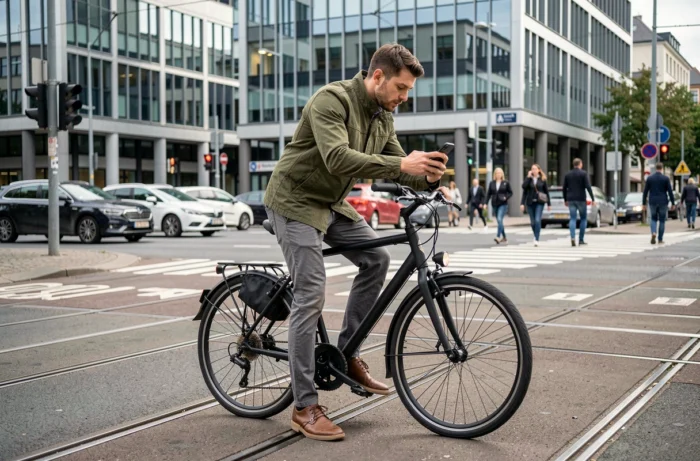
Bicycles, even in dense urban environments, benefit from superior visibility due to the seated position and larger wheels. Stability on degraded road surfaces (cobblestones, tram tracks, potholes) remains significantly better than on scooters, where small wheels amplify every irregularity.
On the other hand, electric scooters expose users to specific risks: high center of gravity, less progressive braking, increased vulnerability during interactions with motor vehicles. The accident rate for scooters has increased much faster than their modal share, raising questions about the very design of these devices for intensive daily use.
Range and Trip Distance: Where the Shift Occurs
For trips under five kilometers on flat terrain, electric scooters remain functional. Beyond that, bicycles (electric or mechanical) offer better energy efficiency and superior comfort over time.
The range advertised by scooter manufacturers rarely corresponds to actual use. The weight of the rider, elevation, outside temperature, and battery condition significantly affect the distance traveled. The real range of a scooter is often one-third less than the advertised range.
The electric-assist bicycle compensates for these variables better thanks to the cyclist’s effort and generally larger capacity batteries. On a trip of eight to ten kilometers with elevation, the EAB maintains stable assistance where the scooter loses power as soon as it encounters the first serious hill.
- Short and flat trip (less than 5 km): the scooter remains competitive, especially when combined with public transport due to its foldability.
- Mixed trip with elevation or distance greater than 5 km: the bicycle, even non-electric, offers a clear advantage in comfort and consistency.
- Daily trip over 10 km: the EAB becomes essential, while the scooter becomes burdensome (range, fatigue from standing, travel time).
Actual Budget and Cost of Use: Beyond the Purchase Price
The purchase price of an entry-level electric scooter is lower than that of a decent urban bicycle. This initial difference quickly diminishes when ancillary costs are factored in.
Liability insurance is mandatory for electric scooters, as they are classified as motorized land vehicles. The mechanical bicycle does not have this obligation. The addition of mandatory helmets in certain departments, the replacement of the battery (whose lifespan is measured in charge cycles), and the maintenance of solid or inflatable tires increase the overall cost.
For bicycles, maintenance costs are better documented, and spare parts are more standardized. A well-maintained urban bicycle lasts several years without the need for major component replacement. The electric scooter, on the other hand, experiences faster obsolescence, particularly regarding the battery and electronic controller.
What the Budget Doesn’t Say
Field feedback varies on this point, but several regular users note that the resale of a used bicycle retains better value than that of a scooter. The second-hand market for electric scooters remains poorly structured, complicating the recovery of part of the investment.
Scooter or Bicycle in the City: Choice Criteria Based on Usage Profile
The choice is not just a matter of distance or price. The local regulatory framework, the configuration of the route, and the storage capacity at home and at work weigh equally.
- You combine public transport and the last mile: the foldable scooter remains relevant, provided you accept the equipment constraints (helmet, vest) and the weight to carry up stairs.
- You regularly transport groceries or a child: the bicycle, with a luggage rack or child seat, has no equivalent on the scooter side.
- You ride in an area covered by the EDPM helmet requirement: the additional cost and logistical constraint of daily helmet use weigh in the balance, especially for short trips.
- You seek regular physical effort: the mechanical bicycle offers real calorie expenditure, while the electric scooter engages the body very little.
The increase in accidents and the tightening of regulations in 2025-2026 have reshuffled the cards. A choice that seemed obvious two years ago, based on price and practicality, deserves to be reevaluated today by incorporating safety and the local legal framework. The available data does not yet allow for measuring the effect of the new helmet obligations on accident rates, but they are already changing the daily experience of scooter users.