
Frankfurt sausage, Frankfurter Würstchen, hot dog: behind these names lies a genealogy that few consumers suspect. The history of this sausage is not just a German recipe exported across the Atlantic. It traverses disputes over paternity between cities, European legal protections, and a radical transformation of its use, from a medieval fair dish to a symbol of global fast food.
Frankfurter Würstchen vs. Wiener Würstchen: the paternity dispute
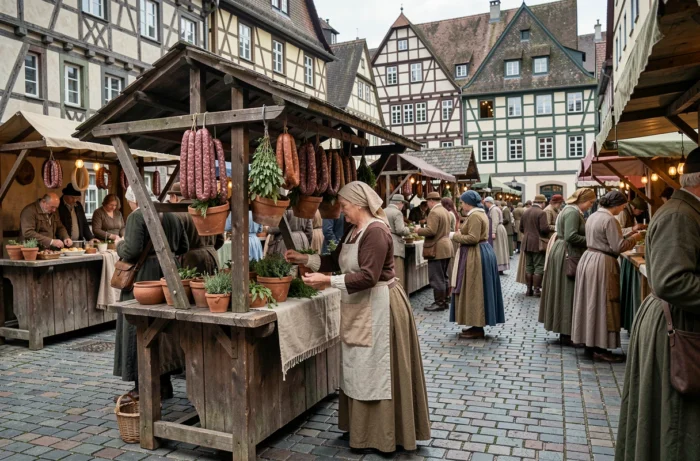
Two cities claim the title of the most famous sausage in Central Europe. Frankfurt am Main traces its origins back to the Middle Ages, where smoked pork casings were served at trade fairs. Vienna, on the other hand, attributes the modern version to Johann Georg Lahner, a butcher from Frankfurt who settled in the Austrian capital in the 19th century.
Lahner is said to have combined Frankfurt’s know-how with the addition of beef, creating a distinct product. Therefore, the Viennese call this sausage “Frankfurter,” while the people of Frankfurt refer to the Viennese version as “Wiener.” Each city refuses to use its own name to refer to the rival product.
| Criterion | Frankfurter Würstchen (Frankfurt) | Wiener Würstchen (Vienna) |
|---|---|---|
| Main meat | Pork only | Mix of pork and beef |
| Casing | Natural sheep casing | Natural or artificial casing |
| Smoking | Cold smoked with beech wood | Hot smoked |
| Caliber | Thinner, shorter | Thicker |
| Historical claim | Medieval fairs of Frankfurt | Johann Georg Lahner, 19th century |
This distinction is not trivial. To better understand the origins of the Frankfurt sausage, one must realize how much the original recipe (pure pork, sheep casing, cold smoking) differs from the industrial product that large retailers offer today under the same name.
European geographical protection: the name Frankfurter Würstchen framed by law
The debate between Frankfurt and Vienna has found a legal extension. The name Frankfurter Würstchen is protected due to its geographical origin under the European system of protected designations. Only sausages produced according to specific specifications in the Frankfurt region can bear this name.
This type of protection (g.g.A. in Germany, equivalent to IGP in France) imposes constraints on production and origin. This approach is part of a broader movement to enhance German specialties: the Frankfurter Grüne Soße, an iconic green sauce from the same city, received its own protection in 2016.
In practice, this regulation creates a clear gap between the protected product and sausages sold as “Frankfurt type” elsewhere in Europe. The composition differs, as does the smoking process. The Frankfurt sausage sold in France often has nothing to do with the protected Frankfurter Würstchen.
From Frankfurt to the American hot dog: a migration via street carts
Most accounts summarize the transition from Frankfurter to hot dog with a phrase like “German immigrants brought it to the United States.” The reality is more precise and tied to a specific economic context.
The spread of the Frankfurt sausage as a cheap street product is directly connected to American industrialization in the second half of the 19th century. German migration waves brought butchers trained in smoked charcuterie, who adapted their production to the constraints of the American urban market:
- Quick cooking on mobile carts set up near factories and train stations, catering to workers’ staggered schedules
- Elongated bread serving as both packaging and cutlery, eliminating the need for a plate or fork
- Very low prices due to the use of mixed meats (pork, beef, veal), which already distanced the product from the original Frankfurt recipe
The hot dog is not a simple export of the Frankfurter, but a reinvention dictated by the conditions of industrial street food. The product Americanized in a few decades, losing cold smoking, natural casing, and the purity of pork meat in favor of large-scale standardized production.

Frankfurt sausage and Strasbourg sausage: two distinct products confused in France
In the French market, the confusion between Frankfurt sausage and Strasbourg sausage is almost systematic. The two look similar visually, but their compositions diverge.
The Strasbourg sausage traditionally contains a mix of pork and beef, with a significant proportion of fat. Its casing is often dyed with annatto, giving it a characteristic orange color. The Frankfurt sausage, in its original version, uses exclusively pork and retains a paler hue linked to smoking.
In French retail, both names frequently refer to the same industrial product. The specifications are not comparable to those imposed by German geographical protection. A consumer buying “Frankfurt sausages” in a supermarket acquires a product whose composition (pork meat at varying levels, water, fat, salt, preservatives) significantly deviates from the historical recipe.
Typical composition in French retail
According to available data on common labels, a sausage sold under the name “Frankfurt” in France generally contains pork meat (around two-thirds of the product), water, pork fat, salt, and preservatives. Smoking, when it exists, is often replaced by a liquid smoke flavor.
This standardization explains why the Frankfurt sausage is perceived in France as a low-end product, while it enjoys a status in Germany comparable to that of a protected regional charcuterie. The gap between the original product and its industrialized version remains one of the most striking paradoxes in European food history.