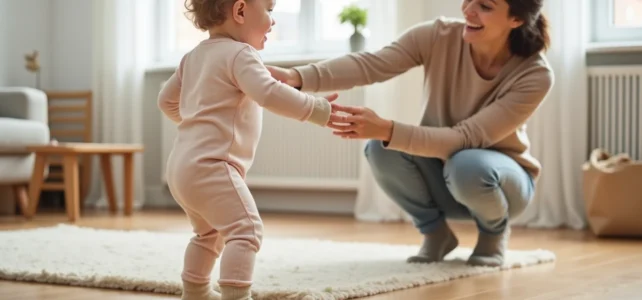
Most babies start walking between 10 and 18 months, depending on their muscle tone, temperament, and the opportunities they have had to move freely on the floor. Supporting a baby’s first steps is not just about holding their hands: the type of surface, the supporting posture adopted by the adult, and the time spent in front of a screen directly influence the quality of this motor learning.
Screens before 18 months and the motor skills of first steps
A rarely discussed angle in parenting guides concerns the link between early exposure to screens and the acquisition of walking. When a baby spends time sitting still in front of a tablet or phone, they lose as many opportunities to practice the postural changes that prepare them for their first steps: getting up, falling, catching themselves, rolling.
The Saudi Ministry of Health recommends avoiding giving electronic devices to children under 18 months, precisely because it reduces active exploration time on the floor. Several prevention guides echo this position, emphasizing that time spent in front of a screen decreases opportunities to practice transitional postures.
Specifically, a baby who crawls, pulls themselves up along furniture, or falls back onto their bottom trains their proprioception and strengthens the muscles in their pelvis, ankles, and feet. Every minute spent on the floor counts. Replacing a screen with a free motor skills mat, even without a specific toy, is enough to multiply these natural micro-exercises that prepare for more confident first steps.
To find suitable equipment for learning to walk and free motor skills, a useful resource is: https://www.mespetitspas.fr/, which offers products designed to support little ones in this stage.
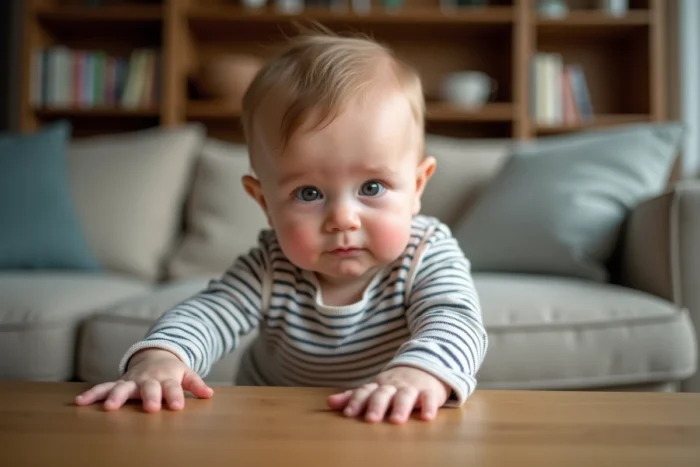
Supporting the pelvis rather than the hands: the posture that changes everything
The most common reflex is to hold the child’s hands to help them move forward. This posture seems logical, but it poses a biomechanical problem: raised arms shift the center of gravity upwards and prevent the baby from finding their own balance.
The approach recommended by several early childhood professionals is to squat behind the child and support their pelvis, hands placed on their hips. This position allows them to keep their arms free to compensate for imbalances, just as they would when walking alone.
The difference is visible within a few days. A child supported at the pelvis learns to engage their foot supports, to slightly bend their knees, and to pivot their torso independently. They fall less often, and when they do fall, they know how to better absorb the fall because their arms were not immobilized above their head.
When to stop providing support
There is no fixed timeline. The most reliable signal is the child’s own behavior: when they push your hands away or speed up their pace while detaching, they are ready to move on their own. Forcing a learning pace often delays the development of confidence rather than accelerating it.
Securing the floor and furniture before crawling
Most parents secure their home when the child starts to stand up. Field reports suggest that this is already too late. The recommendation from specialists in preventing household accidents is to get down on all fours yourself and identify dangers at child height before they even start crawling.
Three categories of risks deserve particular attention:
- Falls: corners of low tables, unprotected steps, unstable furniture that a child could pull on while climbing. A dresser not secured to the wall can tip over under the weight of an open drawer.
- Risks of suffocation and choking: small objects on the floor (coins, pen caps, marbles), accessible curtain cords, plastic bags within reach.
- Pinch points: door hinges, sliding drawers, legs of folding chairs. Door stoppers and hinge protectors significantly reduce these risks.
A room-by-room audit, done on your knees, takes about twenty minutes and prevents the majority of accidents related to early movements.
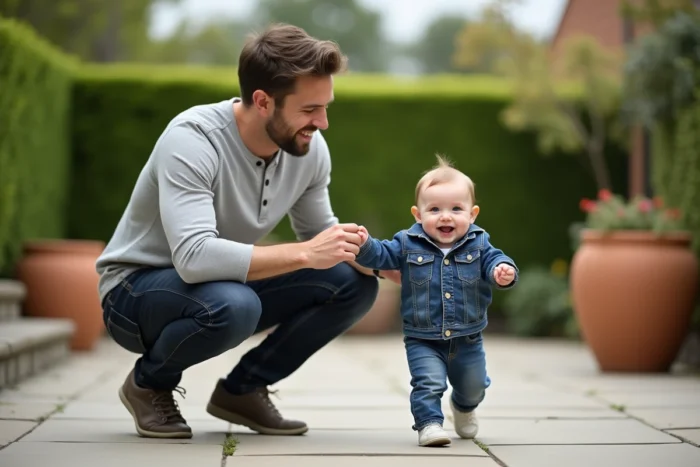
Barefoot, soft slippers, or shoes: what does biomechanics say?
The debate between barefoot and shoes comes up in every discussion among parents. The data converge on one point: bare feet remain the best option on a clean and secure indoor surface. Direct contact with the ground allows the foot to strengthen, capture sensory information from the terrain, and develop the arch.
Outdoors or on cold surfaces, soft slippers with thin soles best replicate the barefoot sensation while protecting the skin. Rigid shoes, with thick soles and high tops, limit the natural flex of the foot and alter the gait. They are only useful on abrasive or very uneven surfaces.
Criteria for choosing first-step slippers
- Thin and flexible sole: the slipper should be able to be bent in half effortlessly.
- Breathable material (soft leather, technical fabric) to prevent excessive sweating.
- Adjustable closure (elastic, Velcro) that holds the slipper without compressing the foot.
- Absence of heel, even minimal: a heel alters weight distribution and disrupts the balance of a child learning to walk.
The motor development of each child follows its own timeline. A baby who is not walking at 14 months is not delayed as long as they are progressing through the intermediate stages (pulling up, cruising along furniture, standing for a few seconds). The most effective support remains a clear floor, free feet, and an adult present at the right height, without rushing.