
Changing a passenger’s name on an EasyJet booking is not merely an administrative correction. The British airline treats this operation as a ticket transfer to another person, which explains a pricing framework and stricter conditions than many travelers anticipate. Understanding the actual mechanics of this procedure helps avoid unnecessary fees or boarding denials.
EasyJet Passenger Transfer: A Different Logic from Error Correction
The fundamental distinction to grasp concerns the nature of the operation itself. EasyJet does not offer a simple spelling correction field like some traditional airlines. The name change is treated as a complete transfer of the ticket to another traveler. This approach opens the possibility of transferring your booking to a third party, but it also involves a fixed cost per passenger and per flight.
For minor input errors (three characters or fewer), the airline allows a free correction via online booking management. Beyond this tolerance, any name modification falls into the transfer category, with systematic billing.
Updated guides in 2026 confirm a fee of £60 per passenger and per flight when the modification is made online. Contacting customer service costs more, with a fee raised to £65.
This price difference between self-service and assisted processing clearly encourages the use of the online management space. Before proceeding, consulting the detailed procedure for changing a name on an EasyJet flight helps anticipate each step and avoid unpleasant surprises.

Online Name Change Procedure at EasyJet
The process is carried out from the “Manage my bookings” section on the EasyJet website or app. The initial passenger or the booking holder must identify themselves with the flight reference and the associated email address.
Once logged in, the section dedicated to name changes appears in the booking options. The new name must exactly match the one on the identification document or passport used for travel. Any discrepancy between the ticket and the identification presented at the airport may result in boarding denial, without recourse or refund.
- The modification must be made before online check-in, which generally opens 30 days before departure
- The transfer applies flight by flight: for a round trip, the fee is charged twice if the name changes on both segments
- Extras already purchased (baggage, reserved seats) are not automatically transferred in all cases, which may incur additional fees
The modification window closes when check-in opens. After this deadline, no name change is possible, neither online nor by phone. The only recourse then becomes the cancellation of the ticket (with the usual restrictive conditions) and the booking of a new flight.
EasyJet Name Change Fees: What the Displayed Rate Doesn’t Always Reveal
The official scale appears simple: a fixed amount per passenger and per flight. In practice, the final bill can increase for several reasons that travelers often discover too late.
First, the fee is expressed in pounds sterling. For passengers who booked in euros, the conversion applied at the time of payment can affect the actual amount. Next, on a round trip, the cost is doubled since each flight segment is charged separately.
Recent feedback shows a strong perceived variability in costs depending on the channel used. Some travelers report charges they consider high for corrections that seemed minor but exceeded the three-character threshold. The gap between the promise of a simple online process and the reality of processing remains a recurring friction point in customer reviews.
Price Difference Between Correction and Ticket Transfer
This confusion between minor correction and complete name change is the main source of disputes. A passenger who has swapped their first name and last name, or who has omitted a second first name appearing on their passport, sometimes finds themselves facing a transfer charge even though it is the same traveler.
Only errors of three characters or fewer benefit from being free. Beyond that, the airline applies the full transfer fee, without distinction between a typo and a passenger change.
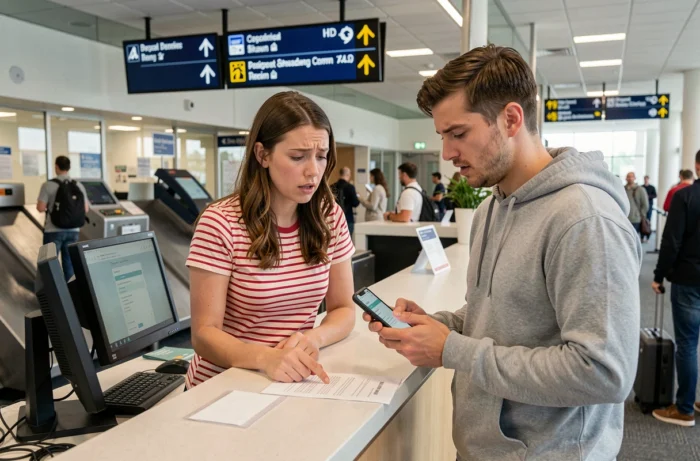
European Regulatory Framework and the Future of Name Change Fees
A debate is emerging in France and several European countries regarding the legality of these correction fees. Reports broadcast in 2026 highlighted situations where passengers were charged amounts deemed disproportionate to rectify a simple input error on their ticket.
The question revolves around proportionality: is charging a full transfer for a typo a justifiable business practice or an abusive surcharge? Several European airlines may soon no longer be able to charge certain name change fees, according to ongoing regulatory discussions. The available data does not allow for a precise timeline, but the regulatory trend points towards stricter oversight.
For travelers, this uncertainty means checking the general conditions at the exact moment of booking, as they may evolve from season to season.
Checks Before EasyJet Booking to Avoid a Name Change
The best strategy remains to avoid the modification beforehand. A few simple checks at the time of booking eliminate the vast majority of problems.
- Enter the name exactly as it appears on the travel document (passport or ID card) used for the flight
- Ensure that the first name/last name order matches the format requested by the booking form
- For travelers who have recently changed their name (marriage, divorce, change of civil status), ensure that the identification document has been updated before booking
- Review the booking confirmation as soon as it is received: an error detected within 24 hours of purchase can be corrected under the cancellation policy, with lower fees
The three-character free threshold remains a limited safety net. A swap of two letters passes, but a missing accent combined with a forgotten letter may be enough to exceed this tolerance. Checking your ticket in the minutes following the booking remains the most effective precaution.