A vegetable garden soil that sticks to boots in spring and cracks in July poses a concrete problem: vegetables stagnate, roots suffocate or dry out. Before looking for commercial fertilizers, much of the problem can be resolved with compost produced on-site. Composting transforms kitchen and garden waste into an organic amendment that restructures the soil, nourishes underground life, and reduces dependence on inputs.
Legal obligation to sort organic waste and composting in the vegetable garden
Since January 1, 2024, sorting organic waste at the source is mandatory for all producers, with no tonnage threshold. This provision, stemming from Article L.541-21-1 of the Environmental Code as amended by the AGEC law (law n°2020-105), also applies to individuals.
In practice, there are two options: separate collection organized by the community or on-site valorization. Home composting is one of the legal ways to manage organic waste. For those cultivating a vegetable garden, it is the most direct solution: peels, greens, and plant scraps return to the soil just a few meters from where they grew.
This obligation changes the game. Composting is no longer a militant gesture; it is a common management method that responds to a specific regulatory framework. Organizations like Terrre d’Humus support this transition by providing resources on the organic valorization of waste.
Compost and soil structure: what changes concretely in the vegetable garden
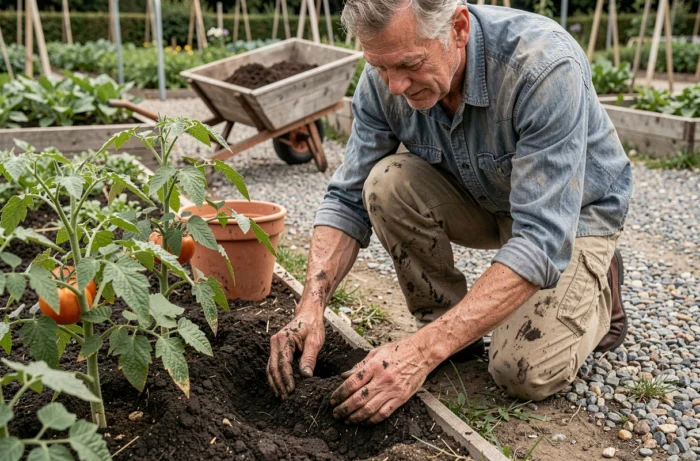
We often talk about “feeding the soil,” but the first visible effect of compost is mechanical. Compacted clay soil becomes more crumbly after a few applications. Sandy soil retains water better. Compost acts as an organic binder that promotes the formation of aggregates, those small clumps of particles that create air pockets and channels for water.
Compost improves both water retention and drainage, which may seem contradictory but is explained by the sponge-like structure of decomposed organic matter. In a vegetable garden exposed to drought episodes, this buffering capacity makes the difference between tomatoes that hold up and plants that wilt after just three days without rain.
Dosages according to crops
Not all plants in the vegetable garden react the same way to compost applications. ADEME data distinguishes three categories:
- High-demand plants (tomatoes, squash, zucchini, leeks, eggplants, potatoes) can handle the most generous applications, around 3 to 5 kg per square meter per year.
- Medium-demand plants (carrots, spinach, beans, lettuce, beets) are satisfied with 1 to 3 kg per square meter per year.
- Low-demand plants (garlic, onions, shallots, radishes, aromatic herbs) can do without compost applications.
Applying the same dose everywhere amounts to wasting compost on garlic rows and underfeeding squash. Efficiency is gained by targeting applications.
Soil biodiversity and disease reduction in the vegetable garden
Compost is not limited to a fertilizing role. Recent research shows that regular compost applications modify the microbial diversity of the soil. This is not trivial: biologically active soil suppresses pathogens better than soil sterilized by chemical treatments.
The fungi, bacteria, and microorganisms introduced or stimulated by compost compete with crop pathogens. A reduction in the risk of root diseases is observed in plots regularly amended with compost compared to those that receive only mineral fertilizers.
Insects and beneficial fauna
A soil rich in organic matter attracts earthworms, which are the first indicators of a living soil. Their burrowing activity improves aeration and natural drainage. On the surface, a composted vegetable garden also hosts more beneficial insects (ground beetles, rove beetles) that regulate pest populations.
A composted vegetable garden becomes an ecosystem, not just a production surface. Soil biodiversity works for free where pesticides are costly and deplete the environment.
Practical method for successful vegetable garden composting
Composting relies on a balance between “green” materials (rich in nitrogen: peels, fresh cuttings, vegetable tops) and “brown” materials (rich in carbon: dead leaves, shredded branches, straw, unprinted cardboard). Opinions vary on the ideal proportions, but a visually equal mix works in most situations.
- Loosen the soil under the composter to facilitate the rise of decomposer organisms from the ground.
- Systematically alternate wet layers and dry layers to maintain aeration and avoid anaerobic fermentation odors.
- Turn the pile every three to four weeks to speed up decomposition and homogenize the material.
- Cover the composter (lid, tarp, thick layer of straw) to retain moisture without saturating the pile in case of rain.
Mature compost is recognized by its forest floor smell and crumbly texture. It should no longer contain identifiable pieces of peels or leaves. Under normal conditions, expect between six months and a year depending on the climate and frequency of turning.
When and how to incorporate it
The best time to spread compost in the vegetable garden is in the fall, on the surface, with a light raking. The soil life will incorporate the organic matter during the winter. In spring, it can also be placed between rows of vegetables before mulching on top. For plantings during the season, it is placed at the bottom of the planting hole covered with a thin layer of soil, so that the roots can access the nutrients as they develop.
Composting organic waste to feed the vegetable garden completes a cycle that industrial agriculture has broken. The peels from the previous harvest nourish the next, the soil gains resilience each year, and the gray bin loses a third of its contents. The benefit is as much practical as ecological, measurable from the second season of application.